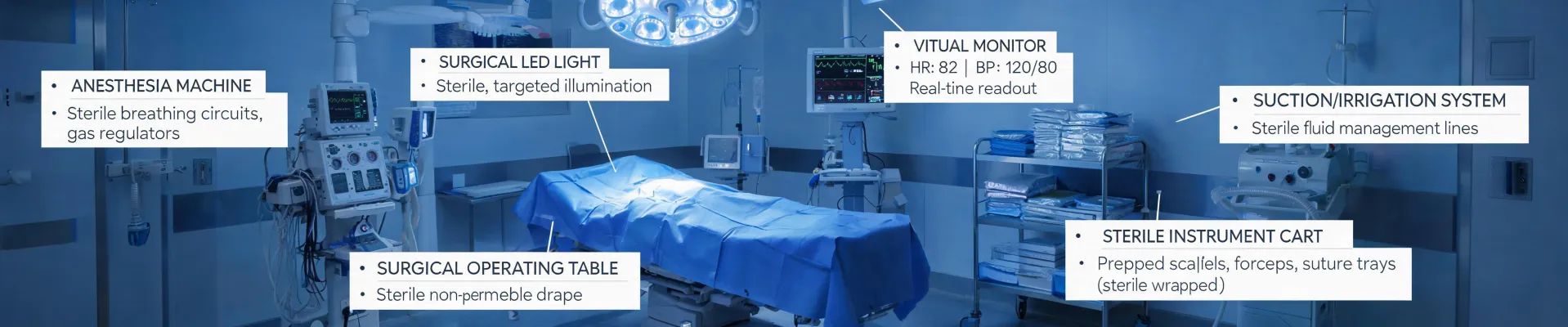
I was about to sign a $54,100 purchase order when the phone rang.
March 12, 2024. I was in my office at a 230-bed surgical hospital, staring at two quotes for the same set of electrosurgical instruments. We were gearing up for a new robotic surgery system launch, and I'd been tasked with sourcing the compatible toolset. One quote was $4,200 cheaper than the other. I almost went with it.
Seriously. The PO was drafted.
My job is measured in savings
Here's some context. I'm the procurement manager at this hospital. I oversee roughly $1.8 million in annual spending on surgical supplies, with Conmed medical devices making up a decent chunk of that. Over six years in this role, I've negotiated with 40+ vendors and built a cost-tracking system that documents every single order.
My TCO spreadsheet — total cost of ownership, not sticker price — is my professional identity. It's caught hidden fees before. It's prevented bad vendor decisions more times than I can count. And it was the reason I caught myself before clicking "submit" on that $54,100 PO.
Here's what almost happened.
The conventional wisdom is wrong for hospitals
Everything I'd read about procurement said to take the lowest responsible bid. That's solid advice for buying office supplies or printer toner. But my experience tracking 300+ surgical supply orders since 2019 suggests otherwise, at least in acute care settings. The "cheapest" option isn't just about the sticker price — it's about the total cost of your time spent managing follow-ups, the clinical risk of a missing instrument on surgery day, and the quiet expense of rescheduling a procedure because a delivery window slipped. That last one isn't on most TCO templates. It should be.
But I didn't know that yet. I was still looking at the $4,200 difference and thinking about my quarterly budget review.
The quote that looked too good
Our hospital had just approved the capital purchase for a new robotic surgery system. The general surgery team needed compatible laparoscopic instruments — electrosurgical pencils, grounding pads, access trocars, tubing. The kind of line items you page through in the Conmed catalog under "Advanced Surgical." About 40 SKUs total.
I sent the list to three suppliers:
- Vendor A — authorized Conmed distributor. $58,300. Full warranty, clinical support, five-year service plan.
- Vendor B — a national reseller with "aggressive pricing." $54,100. No service plan mentioned.
- Vendor C — another authorized distributor. $56,800, which felt like a baseline.
Vendor B was tempting. Like, way tempting. $4,200 is a 7.2% swing on a single order — the kind of number that gets flagged as a win in quarterly reviews.
Then I read their terms. Twice.
The fine print nobody volunteers
Shipping: $1,950, not in the quote. Annoying but normal. Then a $675 "order processing" fee showed up in the payment portal — not in the original PDF. The most frustrating part of vendor management: the same issues recurring despite clear communication. You'd think a written quote would include all fees, but interpretation varies wildly.
The warranty was 90 days. Ninety days for electrosurgical instruments that the Conmed catalog backs for two years through authorized channels.
And the delivery date. Eighteen business days for the specialized laparoscopic instruments. Our go-live was six weeks out, so it would technically work. Zero buffer. Not a single day of cushion.
I told myself it was fine. I told myself the surgeons would understand if something arrived late. Then the phone rang.
A trocar for a heart valve replacement
It was Dr. Patel from cardiac surgery. A 67-year-old patient with severe aortic stenosis needed a heart valve replacement on April 2. The team needed a specific AirSeal access trocar from the Conmed catalog, and the supply cabinet was empty.
"Can you get us one by next Friday?" she asked. "This patient can't wait."
I called Vendor B. "Eighteen to twenty business days." The rep didn't even apologize.
I called Vendor A. "Two in stock at the Denver warehouse. You'll have them tomorrow morning."
That's when the math hit me.
A heart valve replacement case is roughly $18,000 in reimbursable revenue. Add the surgeon's block time, OR staff scheduling, anesthesia availability, patient safety — the true cost of missing April 2 is probably closer to $22,000. Maybe more. So the $4,200 "savings" from Vendor B would have been the most expensive discount in my entire procurement career.
And the exact same logic applied to the 40-line-item robotic surgery system order. If any single component came late, the whole go-live date slipped. Surgeon schedules. Coordinator hours. OR certification windows. In that order. The zero buffer I'd accepted wasn't a logistics detail — it was a clinical decision wearing logistics clothing.
Around the same time, a new junior buyer asked me a question that reframed all of this. She said, "I know this is basic, but what is a stent, exactly? Like, how does it work during a heart valve replacement?"
I gave her the textbook answer — a small, expandable mesh tube that keeps an artery open. She nodded and said, "So the patient's life depends on having the right device available at the right moment."
She was talking about stents. But it applied to our entire supply chain.
The lesson hit me: in this industry, timing isn't a line item. It's the line item.
What I did instead
I canceled the Vendor B order. Signed with the authorized Conmed distributor. Paid the extra $4,200.
The robotic surgery system launched on schedule. All 40 instruments arrived five days before go-live. The heart valve replacement happened on April 2, and the patient recovered. I don't know his name, but I know his surgeon used equipment that was there, in the building, ready, because we prioritized certainty over a discount.
Per FTC guidelines (ftc.gov), supplier advertising must be truthful and substantiated with evidence. In our experience, that's not just about marketing claims — it's about quote accuracy. The "deep discount" reseller buried shipping, processing, and handling fees that turned a 7% savings into a rounding error once clinical risk was factored in.
A few weeks later, I added two rules to our procurement policy:
- Critical-path items require a confirmed delivery SLA from an authorized distributor whenever the clinical date is inside the requested window. No exceptions for savings under 10%.
- Discount quotes automatically get a TCO line item labeled "delivery certainty risk" — estimated at 15% of order value when we have zero buffer.
Was the premium worth it?
Look, I'm not going to tell you to always buy through authorized distributors and never consider a discount vendor. For high-volume consumables with flexible timelines, discount supply chains can work fine. I'm not 100% sure our policy would even make sense for every hospital. Take this with a grain of salt — it's one buyer's experience.
But if you're ordering Conmed medical devices or surgical instruments that providers depend on for scheduled procedures, take a hard look at what delivery certainty actually costs. Not the invoice. The whole picture.
That $4,200? It bought us something I now consider a bargain: certainty. Period.
And if you've ever sat through a budget review explaining why a surgery was canceled due to supply chain failure, you already know the real cost. It's way more than 7%.
Take it from someone who almost found out the hard way.

Jane Smith
I’m Jane Smith, a senior content writer with over 15 years of experience in the packaging and printing industry. I specialize in writing about the latest trends, technologies, and best practices in packaging design, sustainability, and printing techniques. My goal is to help businesses understand complex printing processes and design solutions that enhance both product packaging and brand visibility.