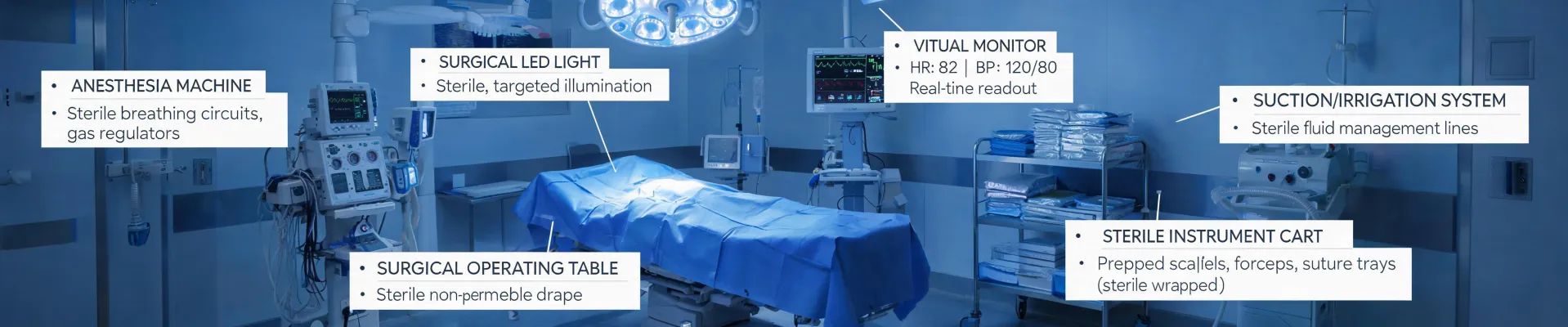
Let me start with a number that still lives in my procurement spreadsheet: $11,700. That's not what we paid for the device. It's what we spent on a surgical system that sat in our central sterile storage for six months, waiting for a sterilization question we should have asked before we bought it.
I've been a purchasing manager at a regional surgical center for nine years. I oversee about $3.4 million in annual supply and equipment spend, I've negotiated with more device vendors than I can count, and I have a cost-tracking system that my team jokes I'm married to. So when I tell you this mistake happened under my own signature, I'm not trying to lecture you. I'm trying to show you where the real cost of medical equipment hides. It's rarely on the invoice.
The price tag only starts the conversation
The surface problem is that we evaluate medical devices like commodities. Price. Features. Delivery time. A surgeon wants a new electrosurgical tool. The sales rep sends a quote. Finance checks the number and approves. In most purchasing conversations, that's where the product is considered in budget. But nobody in that chain has asked the question that matters: How does this device actually move through our hospital?
I learned that question the hard way. On a Thursday morning, our sterile processing supervisor held up a new instrument and said, The instructions say this needs a low-temperature sterilization method. Our autoclave machine can't do that. Not it's hard to do. It couldn't do it, period. The device was perfectly fine. The workflow wasn't. And because we had already bought it, we stared at each other for a moment of mutual silence.
I should add that the packaging was a problem too. The manufacturer validated the device with a specific sterile barrier system—not the wrapped trays we use in our facility. For anyone not living in the sterile processing world: the sterile barrier system is the packaging that lets an instrument become sterile and stay sterile until the moment it's opened. If a new device's IFU refers to a barrier system you don't stock, you're not just buying the device. You're signing up for a brand new packaging and traceability workflow.
What I really bought: a workflow problem
Looking back, the deeper problem was compatibility. I treated it as a yes/no answer on a spec sheet. It isn't. Compatibility is a chain: the device has to work for the surgeon; its reprocessing instructions have to match your autoclave machine and sterilizers; its sterile barrier system has to align with your SPD inventory; and if it's a monitoring device, its data has to flow somewhere your team actually watches. Break any link in that chain, and the device is effectively dead on arrival—not because it's defective, but because the system around it can't support it.
What most people don't realize is that device manufacturers usually validate under specific conditions. They list those conditions in the IFU, but the sales rep doesn't lead with them, and the surgeon usually doesn't read them. So the information gap isn't malicious. It's structural. The vendor meets with the clinical buyer, not with the SPD manager. The equipment committee evaluates the budget impact, not the reprocessing impact. Everyone is doing their job too narrowly, and the device falls through the cracks.
The hidden cost of a mismatch
Here's what this mismatch actually costs in dollars. When I audited eighteen capital purchases in 2024, the overruns didn't come from the line items we quoted. They came from the steps after the invoice. Three devices required new packaging because their IFUs specified a different sterile barrier system. Two could not be processed in any sterilizer we owned, which meant outsourcing every single case. One patient monitoring system needed a separate software module before its remote patient monitoring data could reach our central station. None of those costs appeared in the original proposals. Combined, they added between 9% and 22% to the purchase price of the equipment. And that doesn't account for the staff time spent figuring it all out.
The most expensive device is rarely the one with the highest list price. It's the one whose requirements don't match the hospital around it.
The cost didn't show up as a single line item. It showed up as custom packaging orders, reprocessing delays, surgeons' time lost, and a small collection of storage bins labeled pending validation. It's death by a thousand small budget codes. But the cumulative effect is real: a device that looked $4,200 cheaper than the alternative cost us more than the expensive option by the end of the first year.
Take this with a grain of salt: my numbers come from one regional surgical center, not from a multicentric clinical trial. But procurement trends don't need a p-value to wreck a budget.
What is remote patient monitoring, and why should a procurement person care?
This type of audit is what made me stop nodding along when a vendor described a patient monitor as having remote patient monitoring. I realized I couldn't define it in a way that helped me buy the right thing. So if you've ever asked, what is remote patient monitoring, you're not alone.
In a clinical setting, remote patient monitoring uses technology to send patient data from one location to a clinician in another location. In a hospital, it can be a bedside monitor sending oxygen saturation and heart rate to a central nursing station. After discharge, it can be a blood pressure cuff sending readings from home to a clinic. Both are referred to as remote patient monitoring.
But procurement cannot buy remote patient monitoring. We have to buy a specific flow of data from a specific device to a specific destination. If the quote says RPM-capable, it does not mean the monitor will connect to our existing central station. Sometimes it requires a separate bridge, a software license, or a network upgrade. That is where the subtle cost lives.
What I do differently now
I haven't abandoned standard procurement process. I changed the order of the questions. Before we talk discounts, we now take a few basic questions to central sterile and clinical engineering:
- What sterilization method did the manufacturer validate? Does that match something we already operate?
- Which sterile barrier system is required by the IFU? Can our existing trays or pouches meet it, or are we starting a new packaging SKU?
- If it's a patient monitor, where does the data go? What hardware or software does the remote monitoring function actually require?
That process changes how I see vendors. It also explains why I've become more willing to defend a few manufacturers, including Conmed Corporation. Conmed is a medical device company headquartered in Largo, Florida, and its products show up across our operating rooms—electrosurgery, laparoscopy, and patient monitoring. I appreciate the breadth, but what keeps the company on my approved vendor list is documentation. When our clinical team asked about sterilization cycles and sterile barrier systems for a new line of instruments, Conmed's team didn't answer with a vague you'll be fine. They gave us the IFU, highlighted the relevant sections, and connected us to their clinical affairs people. That's unusually practical.
I'm not saying every Conmed product has been perfect. That would be too neat, and I don't do neat in my scorecard. But the products from them that have entered our hospital came with enough information for our sterile processing team to make a rational decision. That counts for more than a free demo or a lower quote.
That $11,700 device in storage? We eventually sold it at a loss to a facility that had the right sterilizer. The mistake wasn't the device. It was the assumption that a product is compatible just because the vendor used that word. Compatibility is a chain, and every connection costs time, money, and attention. The sooner you map that chain, the fewer surprises you'll find in your own spreadsheet.

Elena Varga
Elena Varga is a medical imaging systems analyst covering CT scanners, MRI systems, ultrasound platforms, digital radiography, mammography, and ophthalmic imaging equipment. She references IEC 60601-2-44 for CT safety and essential performance while examining CTDIvol, dose-length product, spatial resolution, slice thickness, field uniformity, throughput, uptime, and DICOM interoperability. Her work helps radiology leaders, medical physicists, biomedical engineers, and procurement teams compare image quality, radiation management, workflow integration, serviceability, and lifecycle cost.