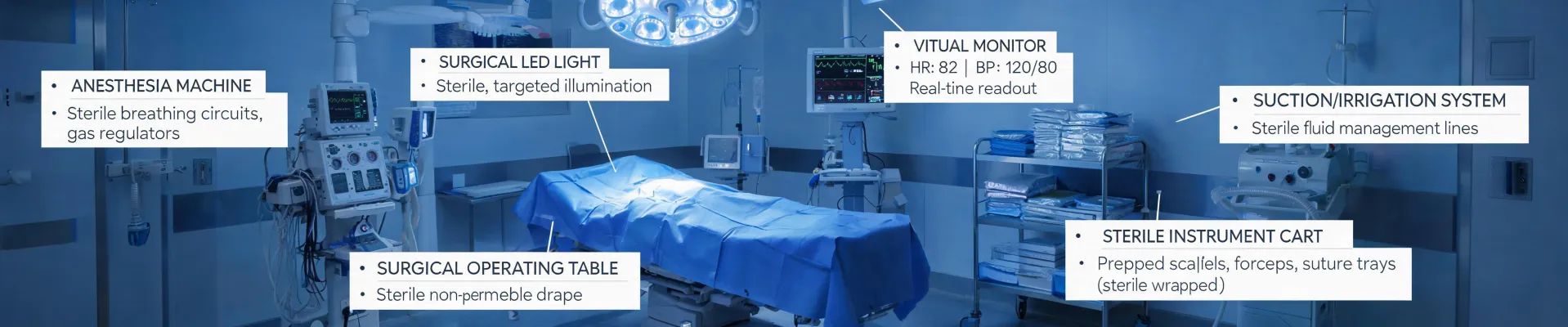
The device that passed every check and still failed
A device arrives. It matches the description on the purchase order. It matches the spec sheet the vendor sent over. It matches the price you negotiated two months ago. And within a week it's parked in a storage room, because it doesn't fit the workflow it was bought to serve.
Everyone reaches for the same explanation. The vendor oversold. The buyer didn't ask enough questions. Somebody says "next time we'll be more careful," everyone nods, and the next order repeats the pattern almost exactly.
I've reviewed device documentation and supplier submissions for about six years — roughly 200 items a year, everything from surgical energy platforms to patient monitoring hardware. The pattern isn't a vendor problem or a buyer problem. It's a language problem, and it lives one layer beneath where most people look.
What you understood was the category, not the device
Ask someone what a nebulizer machine does and you'll get a clean answer: it turns liquid medication into an aerosol you inhale. Ask what a CT scan machine does and you'll get something similar. Type "what is an endoscope" into a search bar and you'll have a definition inside the first paragraph.
That's genuinely useful. It's also, for procurement purposes, close to useless.
Category knowledge tells you what a device is for. Specification knowledge tells you whether a specific unit will work in your specific room, with your specific staff, on your specific cases. Those are different skills, and the internet only teaches the first one.
Here's where it bites. You read that a device is "compatible with standard systems." You read that it "supports high-flow delivery" or "meets industry specifications." None of those phrases is false. All of them are unfalsifiable — and an unfalsifiable claim passes every review you can run on paper.
I'm not a clinician, so I can't speak to whether a given device is clinically appropriate for a patient population — that conversation belongs to your surgeons and your clinical engineering team. What I can tell you, from a compliance standpoint, is that "compatible with standard systems" has never once survived contact with a real installation. Not the way the buyer read it, anyway.
The deeper cause: descriptions get written for the sale, not the spec
The reason this keeps happening isn't that vendors lie. It's that descriptions get written at the level where they're safest — broad enough to be true everywhere, specific enough to sound meaningful.
"Meets industry standard" is the clearest offender. It sounds like a measurable commitment. It isn't one, because nobody in the room can name which standard, which revision, or what the tolerance actually is. I've sat in meetings where three people used that phrase and no two of them meant the same thing.
Per FTC advertising guidance (ftc.gov/business-guidance/advertising-marketing), objective product claims must be truthful, not misleading, and substantiated before they're made. But substantiation is the vendor's burden — and if a buyer never asks for the underlying data, nothing forces the claim to ever show its limits.
The information asymmetry isn't a conspiracy. It's just the default state of the market. The buyer decides using category knowledge. The vendor describes at the category level. Both sides walk away believing they agreed on something.
They didn't. They agreed on a word.
The part nobody writes down
Manufacturers rarely publish device-level specs because those specs are boring, hard to maintain, and occasionally unflattering. A category page converts. A tolerance table doesn't. So the buyer learns the category, the vendor sells the category, and the specification — the only thing that actually determines whether the device works — gets negotiated in an email thread at 4:50 on a Friday.
What it costs when the words don't match
Let me put numbers on this, because "miscommunication" sounds like a soft problem and it isn't.
In early 2024 we received a batch of device accessories where a connector spec was visibly off — about 1.5 mm outside what our documentation required. Normal tolerance on that component is 0.3 mm. The vendor's position was that it fell "within industry standard." Maybe it did. It didn't fit our equipment, which is the only standard that mattered to us. We rejected the batch and they redid it at their cost, which was the correct outcome and still cost us six weeks of scheduling. (Should mention: we'd built a three-week buffer into that order, which is the only reason the delay never touched patient scheduling. That buffer was luck, not planning.)
The more expensive version of this doesn't show up as a rejection. It shows up as friction:
- Staff training that has to be redone for a workflow that changed after installation
- Reprocessing and sterilization procedures that need revalidation against the actual device
- Cases quietly pushed to a later block because the equipment isn't where the schedule assumed it was
- The slow erosion of clinical staff trust in the procurement process — which is the costliest one, and the one that never appears on a report
The most frustrating part of this job: the same failure recurring after everyone has clearly agreed it won't. You'd think written specifications would end the debate, but interpretation drifts. Different reader, different shift, different assumption about what "standard" means. The vendor is "flexible." What I mean is they'll negotiate on price if you push and hold firm on spec — two very different things that sound identical in a meeting.
What actually works, and it's smaller than you'd expect
I'm not going to hand you a forty-page framework. The fix is narrower than the problem.
- Translate every category phrase into a measurable one before the order. "Compatible with standard systems" becomes "connector type X, rated to Y, verified against items 1–14 on our current equipment list."
- Ask for substantiation, not the claim. If a capability can't be traced to a published spec or a test result, treat it as marketing until someone proves otherwise.
- Build the verification step before acceptance, not after installation. Once the device is bolted to the floor, your negotiating position is gone.
- Use documentation as a filter. Manufacturers that publish detailed, device-level specifications make this easier — and the ones that don't are telling you something.
On that last point: a Conmed company overview of medical devices is a decent example of the category-breadth problem — the portfolio spans surgical instruments, endoscopy, electrosurgery, patient monitoring, sports medicine, and laparoscopic systems, and no single summary page will tell you whether a specific unit fits your room. What you actually want is the device-level documentation, and for existing customers that typically lives behind your Conmed login, alongside the spec sheets and compatibility data. Read that before the purchase order, not after. The login is the least glamorous part of the whole process and it's where the real decisions are made.
This was accurate as of early 2025. Device specs, standards, and clearance documentation change, so verify current details before you commit to an order — don't take my word for a tolerance I quoted from last year's file.
The device was never the problem. The word you used to describe it was.

Elena Varga
Elena Varga is a medical imaging systems analyst covering CT scanners, MRI systems, ultrasound platforms, digital radiography, mammography, and ophthalmic imaging equipment. She references IEC 60601-2-44 for CT safety and essential performance while examining CTDIvol, dose-length product, spatial resolution, slice thickness, field uniformity, throughput, uptime, and DICOM interoperability. Her work helps radiology leaders, medical physicists, biomedical engineers, and procurement teams compare image quality, radiation management, workflow integration, serviceability, and lifecycle cost.