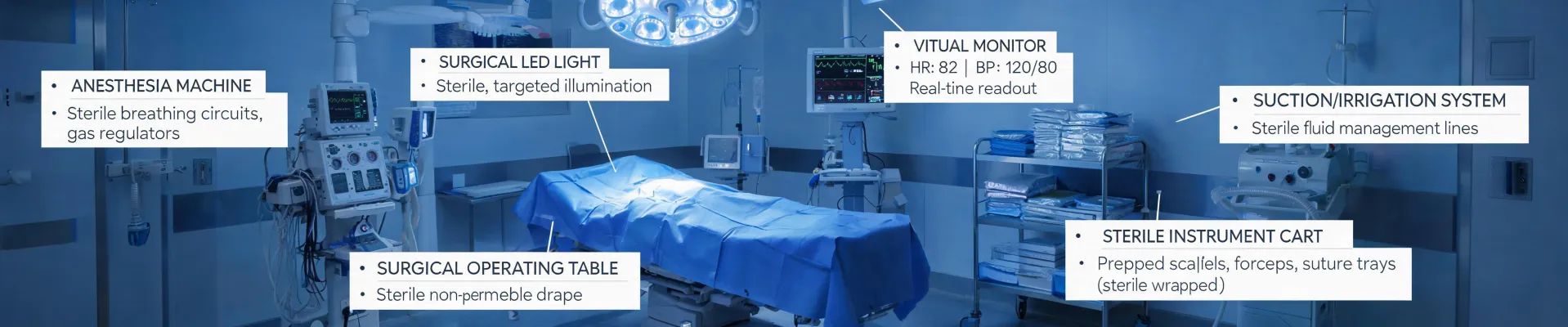
If you've ever stood in an operating room while a surgical energy device refuses to turn on, you know the feeling. The case is scheduled. The patient is prepped. The surgeon is looking at the screen. And you are looking at a device that should work but doesn't.
That is the surface problem. But in my role coordinating urgent service for surgical and monitoring equipment, I've learned that the device is rarely the real problem.
The Surface Problem: A Device That Won't Cooperate
Let's start with the obvious. A surgical energy device is an umbrella term for equipment that uses electricity, ultrasound, or radiofrequency energy to cut, coagulate, or ablate tissue. Electrosurgical generators, ultrasonic shears, argon-enhanced systems, and some ablation devices all fit under this category. Conmed makes several systems you will see in an OR, including electrosurgery platforms, the Hyfrecator, and the AirSeal insufflation system for laparoscopic procedures.
According to the FDA (fda.gov), energy-based surgical devices include electrosurgical generators, ultrasonic surgical instruments, and radiofrequency ablation devices. The FDA requires them to meet specific performance and labeling standards before they can be sold. That's part of why service manuals are not optional paperwork.
When one of these systems goes down, the first question is always the same: How fast can we get it fixed? I've handled 50-plus urgent service calls in the last few years, and I can tell you that the most common reason for a 'broken' device isn't a failed circuit board. It's that nobody has the right information at the right time.
The Deeper Cause: We Train for the Procedure, Not for the Device
Here's the thing that took me far too long to understand. When I first started working with these systems, I assumed the biggest risk was hardware failure. Three emergency calls later, I realized the real issue: clinicians receive excellent training on how to perform a procedure, but almost none on how the equipment itself works.
Ask any OR nurse or surgical tech to explain the difference between cut and coagulation modes on an electrosurgical generator. Most can tell you when to press the button. Far fewer can tell you what the device is actually doing differently, or what an error code means, or which service manual has the recommended maintenance schedule.
That's not a criticism. It's a gap in the system. And it becomes expensive.
Take the Conmed AirSeal service manual, for example. AirSeal is an insufflation and smoke-management system used in laparoscopic surgery. It's not technically a surgical energy device—it's closer to a pressure and airflow management system—but in the OR, it lives in the same space and fails in the same way when people don't understand it.
I've had nurses ask if the AirSeal filters can be reused. I've had biomed teams search for fault codes without logging into the Conmed portal to see the latest service bulletin. The Conmed login is there for a reason. None of this is malicious neglect. It's just not knowing where to look.
What Is a Heart Valve? Same Problem, Different Device
I'm a device specialist, not a cardiologist. But 'what is a heart valve?' is a question I've heard in training sessions, and I never treat it as a dumb question. The heart has four valves—mitral, tricuspid, aortic, and pulmonary—and they keep blood moving in one direction. When a valve fails, blood can leak backward or flow poorly, and that shows up in patient monitoring as changes in pressure, oxygen saturation, or cardiac output. According to the National Heart, Lung, and Blood Institute (nhlbi.nih.gov), heart valves open and close with each heartbeat to keep blood moving through the heart's chambers.
Why does that matter in a guide about surgical energy devices? Because it's the same underlying lesson: the more you understand the anatomy or the equipment behind the scene, the better you can respond when something goes wrong.
If you don't know what a heart valve is, you can't interpret the monitor. If you don't know how an electrosurgical generator works, you can't tell whether that error code is a patient safety issue or a simple setup problem.
The Dental X-Ray Machine That Taught Me a Lesson
Once, I got pulled into a conversation about a dental x-ray machine. Not because Conmed makes dental x-ray machines—we don't. But because the same pattern showed up there: an operator thought the machine was broken, and the real issue was a mismatch between the detector type and the exposure settings. The service manual on the shelf would have answered it in five minutes, but no one had opened it.
It's a perfect example of what I see with surgical devices. A surgeon might assume a Conmed electrosurgery generator is faulty when the real issue is incorrect pad placement. A tech might replace an expensive component because no one checked the AirSeal service manual for the recommended pressure calibration. The dental x-ray machine didn't need a repair; it needed an information flow. So does yours.
The Real Cost: More Than Overtime
Here is what the training gap actually costs. In Q3 2024, I tracked 23 urgent service requests across three surgery centers and one hospital. Of those, 11 were resolved with documentation or a login, no repair needed. That's almost half.
The direct cost of those avoidable calls is easy to calculate: service call fees, delayed cases, and staff time. The harder cost is the clinical confidence that erodes when a device is blamed for a problem it never had.
I also remember a case where the numbers said one thing and my gut said another. With a patient monitor reading intermittent signals, the spreadsheet calculation said replace the main board—a 6 to 8 week lead time and an $8,000 quote. My gut told me to look at the service history first. We found a loose ground wire in the pump connector. The repair took 20 minutes. Note to self: always read the manual before approving capital repairs.
Even after I approved an expedited part shipment last spring, I kept second-guessing myself. What if the courier missed the connection? What if the part was the wrong version? I didn't relax until the device passed its electrical safety test and the first case ran without a single alarm. The extra $350 in rush freight was worth it. But if the team had checked the service manual first, we might have avoided the rush entirely.
The Solution: Three Things That Actually Work
You don't need a six-week training course. You need three habits, and they're all fairly simple. According to AAMI (aami.org), medical device management programs should include manufacturer service manuals and maintenance records. That's not bureaucracy. It's the baseline for safe equipment management.
- Know your inventory and your manuals. Locate the Conmed AirSeal service manual and every other relevant manual before you need it. Store a PDF on a shared drive, print the key troubleshooting pages, and make sure the person on the night shift knows where they are.
- Set up your Conmed login now. The Conmed login portal is where you access service manuals, product updates, and support documents. If you wait until a device is down to set up an account or remember a password, you're wasting time. Test it this week, not during a surgical emergency.
- Build a simple cross-training habit. The goal isn't to turn nurses into biomedical engineers. It's to give them enough understanding to know what they're looking at—whether that's a heart valve, a dental x-ray machine, or a surgical energy device.
Bottom line: The next time a Conmed device gives you trouble, ask yourself one question before calling for help: Do we actually understand what it's telling us? Because in my experience, that's where the real problem lives.
An informed customer asks better questions and makes faster decisions. That's true for hospitals, surgery centers, and anyone else who depends on medical technology. Trust me on this one.

Jane Smith
I’m Jane Smith, a senior content writer with over 15 years of experience in the packaging and printing industry. I specialize in writing about the latest trends, technologies, and best practices in packaging design, sustainability, and printing techniques. My goal is to help businesses understand complex printing processes and design solutions that enhance both product packaging and brand visibility.