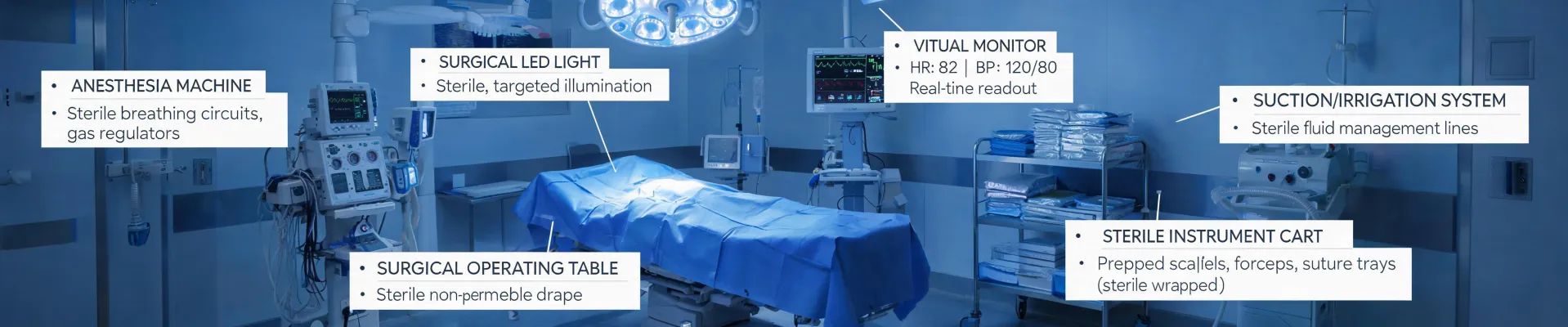
It happens in every hospital. The monitor on the surgical tower starts throwing random numbers. The nurse says the new biosafety cabinet won't stop beeping. The anesthesiologist swaps the pulse oximeter probe for a third time. And someone, eventually, puts in a work order: "Equipment malfunction—please replace."
In my role as an emergency equipment specialist, I've responded to well over 200 of those calls in the last decade. Maybe not 200 exactly—I'd have to check the records—but enough to see the pattern. Here's the uncomfortable truth: most "failed" devices aren't actually broken.
The Surface Problem: Devices That Fail Without Warning
It always starts with a specific event. A surgeon is using an endoscopic camera, and the image looks too dark. The sales rep is blamed, the tower gets quarantined, and a new system is ordered over the weekend. Meanwhile, the real issue? The light source was left in "manual" mode after the previous case, and nobody checked the settings before the next procedure.
It's not a device failure—it's an interface failure. The same thing happens with the pulse oximeter that reads 79% on a patient who's clearly pink. Or the biosafety cabinet that alarms every 40 minutes because the OR air handling system creates different pressure dynamics than the lab where it was tested.
Why It's Almost Never the Device
The Missing Manual Problem
Surgical equipment like the Conmed Hyfrecator 2000 ships with a user manual for a reason. That manual is thick, dry, and easy to ignore—but it contains the exact electrode types, power settings, and duty cycles for specific procedures. Skipping it is like skipping the pre-op checklist: it doesn't end well. I can't tell you how many times I've found a Hyfrecator "malfunction" was simply an inappropriate accessory plugged into the handpiece.
The "One-Size-Fits-All" Assumption
Hospitals love standardization. But medical devices aren't standardized in their quirks. A biosafety cabinet that works perfectly in an academic lab may throw false alarms in an OR because the exhaust airflow is different. An endoscopy tower from one brand may need its light source recalibrated when paired with a scope from another—that's why integrated systems like Conmed endoscopy rigs are designed to work together as a matched set.
But even within a single brand, no device does everything. That's the boundary I'm talking about. The sales rep who tells you one machine handles every surgical scenario is lying—or hasn't spent enough time inside an operating room. Good vendors know their limits. In fact, the vendor who says "this isn't our strength, here's who does it better" earns my trust for everything else.
The Pulse Oximeter's Hidden Weaknesses
The pulse oximeter is a perfect example. It works by shining two wavelengths of light through a fingertip (or earlobe) and measuring the absorption difference between oxygenated and deoxygenated blood. Sounds simple, right? But it's affected by motion, nail polish, poor perfusion, even bright ambient light. Understanding how does a pulse oximeter work helps explain why it sometimes reads 88% on a perfectly healthy patient. The sensor isn't broken—your expectation that it works flawlessly on a moving patient is.
The Robot That Isn't the Problem
Robotic surgery systems are the extreme version of this. They're massive, expensive, and packed with sensors. When a robot throws a fault code mid-case, the team assumes the machine is toast. But in my experience, it's usually a simple misalignment—a docking arm not fully locked, a sterile adapter not seated properly. The system is deliberately designed to stop and alert rather than operate incorrectly. That's not a failure; that's a feature.
The Real Cost of Misdiagnosing Equipment Failure
The financial impact is staggering. The FDA's MAUDE database (I'd cite a specific report, but the numbers change yearly) shows tens of thousands of equipment-related adverse events each year, and a significant chunk come back as user error or accessory mismatch after investigation. Each unnecessary device replacement burns anywhere from $5,000 to $50,000—or more for robotic systems. That doesn't count the surgical delays, the overtime for clinical engineering, or the lost trust between the staff and the equipment.
I remember one case where a hospital sent back a perfectly good Conmed endoscopy system because a resident accidentally changed the color gain settings. The reorder, recalibration, and downtime cost them three days and a mountain of frustration. All because nobody checked the one page in the manual that explains the gain button.
What Actually Works
So the fix isn't to buy new equipment. It's to treat the equipment like the precise tool it is. First, actually read the manual—especially for complex devices like the Conmed Hyfrecator 2000 or a robotic surgery system. The manual is an operating map, not marketing fluff.
Second, create a simple troubleshooting checklist for the team: Are the settings correct? Is the accessory compatible? Is the sensor placed on a well-perfused area? Is the airflow around the biosafety cabinet within spec? Ninety percent of the time, those questions solve the problem.
Third, work with vendors who respect their own boundaries. Conmed makes excellent devices for minimally invasive surgery and patient monitoring. But they'd be the first to tell you a biosafety cabinet isn't their core competency. That honesty is a sign of credibility. When you find a supplier who says "this is our specialty, but for that, talk to this other person," you've found a partner for the long run—not just a salesman.
Next time something "breaks" in the OR, take a breath. Check the obvious. Bring in someone who's seen a hundred similar calls. And remember: the problem is often not the device. It's the gap between what we expect and what the device is actually telling us.

Jane Smith
I’m Jane Smith, a senior content writer with over 15 years of experience in the packaging and printing industry. I specialize in writing about the latest trends, technologies, and best practices in packaging design, sustainability, and printing techniques. My goal is to help businesses understand complex printing processes and design solutions that enhance both product packaging and brand visibility.