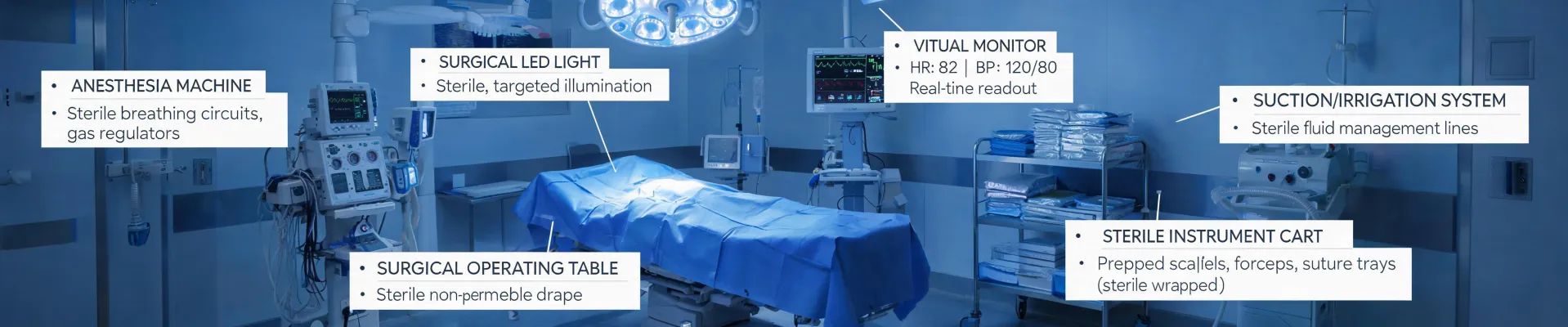
I’ll say the part out loud that most medical supply catalogs won’t: the cheapest equipment quote is usually the most expensive one you’ll ever sign. I didn’t learn that from a webinar. I learned it by buying equipment for a small surgical center.
I’m the office administrator for a 14-person ambulatory surgery center. I manage all equipment and supply ordering—roughly $1.1M annually across 9 vendors. I report to both operations and finance. After 5 years in this seat, I have a file of receipts that taught me more than any sales presentation. This isn’t a rant about a single bad vendor. It’s about a pattern I had to unlearn.
Why I stopped trusting sticker price
When I took over purchasing in 2021, my first instinct was to find the lowest number on the comparison spreadsheet. That felt like my job. It took me about a year and 60 orders to understand that a price is only a price when you know what’s included in it.
What most people don’t realize is that the base quote rarely includes the parts that make the device work. Setup fees, service contracts, consumables, training hours—that’s where the bill grows. Put another way: the quote is the beginning, not the end. The sales manager can give you a beautiful presentation, but the invoice tells you whether they showed you everything.
In 2024, when we consolidated our vendor list, I got burned by one vendor who couldn’t give me an itemized invoice. Finance rejected the expense, and I had to eat the cost from our department budget. That’s when I stopped apologizing for asking for line items.
The Conmed cautery machine that changed my process
In 2022 we needed a new electrosurgical generator. The clinical team called it “the cautery machine,” so that’s what I’ll call it. Conmed Corporation is headquartered in Largo, Florida, and makes medical devices for surgery and monitoring. Their Conmed cautery machine sat in the middle of the pricing pack: not the cheapest, not the priciest.
On paper, it looked fine. But I almost approved the base quote before asking what wasn’t included. The generator itself was the obvious line item. The foot switch, the neutral electrode cables, the smoke evacuation filter—all extra. Here’s something vendors won’t tell you: the first quote is almost never the final number.
I called the Conmed rep and asked for an itemized list. She walked me through the generator, the disposables, the service options, and the training session. The total was higher than the lowest bid, but I knew what I was buying. That made the decision easier. For our surgical volume, the disposable cost per procedure mattered more than the sticker price, and nobody else had shown me that calculation.
(Mental note: I should have asked those questions before the vendor selection meeting, not after.)
Patient monitoring systems are the same story
We hit the same wall when we upgraded our patient monitoring system. The monitors were only half the story. Cables, wall mounts, software licenses, and the hardware to link everything together were separate. The “budget” vendor gave me a sharp quote and then added $4,200 in integration services after we signed. The other vendor showed the full price from day one. Guess which one got the order? (Surprise, surprise: I didn’t want to explain another surprise invoice to finance.)
Per FTC guidance (ftc.gov), advertising needs to be truthful and not misleading. I think pricing should follow the same rule. If a vendor hides fees until after the purchase, that’s not a quote—that’s a down payment. The real price will find you later.
Even the little things: dental loupes and bag valve masks
Transparency matters for big-ticket items, but it matters just as much for the small stuff. We bought dental loupes for two oral surgeons. The low-price pair looked fine in the catalog. Then it needed adjustments, different lens angles, and replacement straps. What we saved on the initial order got eaten up by returns and delays. We ended up buying higher-quality loupes anyway.
A nurse who had just joined the team asked me, “What is a bag valve mask?” She meant the manual breathing bag in every emergency cart. It’s a $20 piece of gear on a good day. But if the supplier doesn’t list the mask, the reservoir bag, and the oxygen tubing separately, you won’t have the complete setup when you reach for it. That’s a deal-breaker in an emergency.
The same logic applies to seemingly small purchases: if someone can’t provide a clear breakdown for a bag valve mask, they don’t understand the product. And if they don’t understand the product, I can’t trust them with a patient monitoring system.
Isn’t a cheaper quote just a better deal?
I get the pushback: “Can’t you negotiate? Aren’t you overthinking this?” Maybe. But I’ve earned the right to overthink it. In 2023, a vendor’s “standard turnaround” quote didn’t include priority shipping. The order arrived a week late, and the delay cost us exactly what that vendor had “saved” us. I only believed in transparent pricing after ignoring it once and eating that mistake.
Look, I’m not saying every low quote is a trap. Some vendors genuinely offer great prices with no hidden strings. But you can’t tell the difference until you itemize. Ask for the full list: components, service kits, loaner devices, fees. If a vendor won’t itemize, that’s a red flag. It’s not the classic “run away” red flag. It’s the “get every promise in writing” red flag.
“The question everyone asks is ‘what’s your best price?’ The question they should ask is ‘what’s included in that price?’”
Bottom line
So here’s where I land: transparent pricing isn’t a nice-to-have. It’s the only way to compare real costs. The Conmed product line has worked well for our OR, and I give their rep credit for walking me through the itemized list without making me push for it. But this isn’t a loyalty speech. It’s a procurement philosophy.
The lowest number on a quote can be a trap if everything else is blank. You’re not buying a machine; you’re buying a working system. And a system only works when someone tells you the total cost from the start. That’s a no-brainer.

Elena Varga
Elena Varga is a medical imaging systems analyst covering CT scanners, MRI systems, ultrasound platforms, digital radiography, mammography, and ophthalmic imaging equipment. She references IEC 60601-2-44 for CT safety and essential performance while examining CTDIvol, dose-length product, spatial resolution, slice thickness, field uniformity, throughput, uptime, and DICOM interoperability. Her work helps radiology leaders, medical physicists, biomedical engineers, and procurement teams compare image quality, radiation management, workflow integration, serviceability, and lifecycle cost.