-
Conmed Equipment FAQs: What Every Surgical Team Needs to Know
-
1. What is Conmed and why does it show up in our OR all the time?
-
2. How do I actually find the right product on the Conmed website?
-
3. What is the Conmed Excalibur Plus and why does everyone want it?
-
4. How does a pulse oximeter work, and does the Conmed one matter that much?
-
5. What is a laparoscope actually used for?
-
6. What is a surgical light and why should I care about the brand?
-
7. What if I need Conmed equipment right now—can I get it faster?
-
8. Are Conmed devices compatible with other manufacturers' systems?
-
1. What is Conmed and why does it show up in our OR all the time?
Conmed Equipment FAQs: What Every Surgical Team Needs to Know
I've been coordinating surgical supplies for a level-1 trauma center for over a decade. When a code comes in and you realize the laparoscope is down or the surgical light just flickered out, you don't have 48 hours to shop around. You need answers and you need them now. This FAQ is built from the questions I get asked most—by nurses, surgeons, and supply chain folks who are tired of brochure-speak. Let's cut through it.
1. What is Conmed and why does it show up in our OR all the time?
Conmed is a commercial medical device company that specializes in surgical instruments, endoscopy, electrosurgery, and patient monitoring. You've probably seen their Hyfrecator or AirSeal system in your hospital. The reason they're everywhere? They've been around since the 1970s and they focus on the stuff that actually gets used in minimally invasive surgery. What I mean is they don't try to sell you an entire robotic system—they make the specific tools your surgeon reaches for during a laparoscopic cholecystectomy or a knee arthroscopy. (Think: the cautery pencil, the pulse oximeter sensor, the scope itself.)
2. How do I actually find the right product on the Conmed website?
Look, I used to waste hours clicking through vendor sites. The Conmed website (www.conmed.com) organizes products by specialty: general surgery, orthopedics, gynecology, etc. But here's the trick—use the search bar with model numbers from your existing inventory. For example, if your OR uses the Excalibur Plus electrosurgical generator, just type "Excalibur Plus" and it'll pull up the specs, accessories, and manuals. Why does this matter? Because searching by vague terms like "laparoscope" gives you 200 results. Searching by part number gives you what your staff already knows how to use.
Real talk: I still kick myself for not bookmarking the support page earlier. If I'd saved the product resource center link, I'd have saved three hours of scrambling during our last JCAHO inspection.
3. What is the Conmed Excalibur Plus and why does everyone want it?
The Excalibur Plus is a electrosurgical generator—the box that powers the cautery tools surgeons use to cut and coagulate tissue. What makes it different from the older models? It has a touchscreen interface and advanced modes like “Ligaseal” for sealing vessels up to 7 mm. The assumption is that a fancier generator will automatically make surgery better. Actually, the real value is consistency: the Excalibur Plus reduces charring and tissue sticking, which means less time spent cleaning the tip during a procedure. That's why it's become the go-to in high-volume ORs. (I've seen one unit handle 15+ cases a day for three years with zero downtime—finally!)
4. How does a pulse oximeter work, and does the Conmed one matter that much?
A pulse oximeter measures oxygen saturation in the blood by shining light through a fingertip or earlobe sensor. Sounds simple, right? But when you're in the middle of a trauma resuscitation and the patient is hypotensive, a cheap sensor will give you false readings. People think that all pulse oximeters are basically the same—but the difference between a $30 generic sensor and a Conmed oximeter is the algorithm. Conmed uses motion-tolerant technology that filters out movement artifacts. Between you and me, I've seen a nurse cancel a case because the generic sensor kept alarming falsely. That delay cost the hospital $2,000 in OR time. Conmed's sensor? Rock solid.
5. What is a laparoscope actually used for?
A laparoscope is a thin, lighted tube with a camera that lets surgeons see inside the abdomen through tiny incisions. It's the backbone of minimally invasive surgery—gallbladder removal, hernia repair, colon resection, you name it. The common misunderstanding is that the laparoscope itself is just a scope. In reality, the image quality and light source matter hugely. Conmed's laparoscopes use HD optics and fiber-optic light cables that give a crisp, bright image even in deep cavities. (I'll never forget a case where a third-party scope fogged up during a critical dissection—never again.)
One of my biggest regrets: not checking the compatibility of the light cable before a robotic case. The Conmed scope uses a specific connector; we grabbed a generic cable and spent 15 minutes fighting with it. Now I keep a spare Conmed cable in every cart.
6. What is a surgical light and why should I care about the brand?
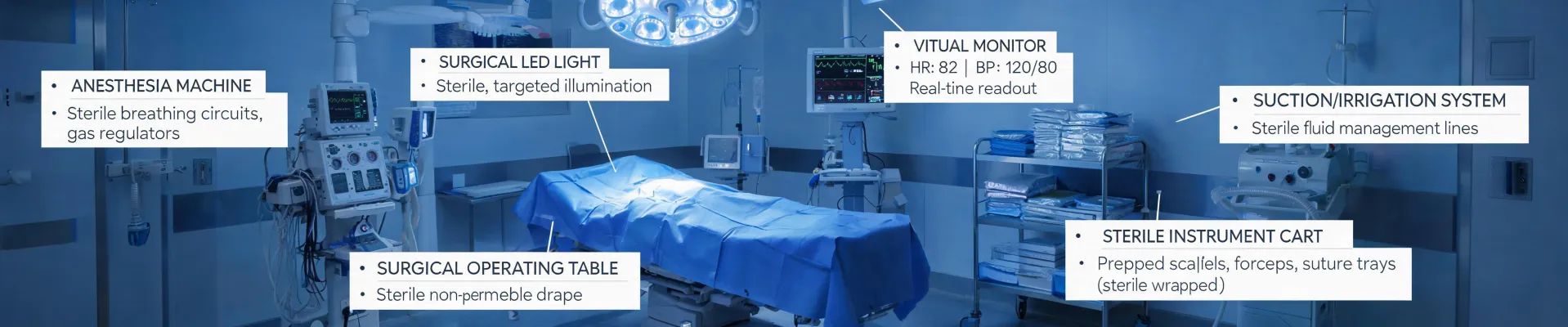
A surgical light is the overhead illumination system that floods the operative field. You'd think all lights do the same thing, but the devil is in the shadows. Cheap lights create hot spots and cast shadows from the surgeon's hands. Conmed's surgical lights—like the Sabre series—use multiple LED arrays and a parabolic reflector to eliminate shadows. I have mixed feelings about buying premium lights: on one hand, the upfront cost stings. On the other hand, when your surgeon is doing a 4-hour microvascular anastomosis and doesn't have to reposition the light once, you remember why you paid for it. (Part of me wants to standardize with the cheapest option for our new outpatient center. Another part knows better—I've seen the dark side of budget lights.)
7. What if I need Conmed equipment right now—can I get it faster?
In March 2024, I had an OR manager call me at 4 PM on a Friday needing an Excalibur Plus for a Monday case (their existing one had just died). Normal order lead from Conmed is 5-7 business days. We found a local distributor with one in stock, paid a 25% rush premium ($1,200 extra on top of the $4,800 base price), and had it delivered Saturday morning. The alternative was canceling three cases and losing $18,000 in surgical revenue. The question isn't whether the rush fee is fair—it's whether the certainty is worth it. In my experience, for emergency needs, paying the premium is cheaper than the alternative.
To be fair, you can avoid most rush situations by keeping a backup unit and using Conmed's online inventory check (they show real-time stock for common items). But when you don't have that buffer, spend the extra money for guaranteed delivery. I've been burned twice by 'probably by Tuesday' promises.
8. Are Conmed devices compatible with other manufacturers' systems?
This one trips up a lot of people. Conmed's laparoscopes and light cables use a standard ACMI connector (or a proprietary one depending on the model). Their electrosurgical generators work with most standard patient return electrodes. But here's the thing—never assume. The assumption is that because the connector looks the same, it'll fit. Actually, the pin configuration varies. I've seen a brand-new Conmed cautery pencil fail to fit an older Valleylab generator because of a subtle locking tab difference. Always check the compatibility matrix on Conmed's website before you buy. (I learned this the hard way and wasted a $200 return shipping fee.)
Summary from the trenches: Conmed makes solid, reliable equipment that earns its place in a busy OR. The key is to know what you need (model-specific), verify compatibility, and never underestimate the cost of uncertainty. Whether it's a pulse oximeter for a sick patient or a surgical light for a long case—when seconds count, buy the equipment you trust and pay for the delivery you can bet on.

Elena Varga
Elena Varga is a medical imaging systems analyst covering CT scanners, MRI systems, ultrasound platforms, digital radiography, mammography, and ophthalmic imaging equipment. She references IEC 60601-2-44 for CT safety and essential performance while examining CTDIvol, dose-length product, spatial resolution, slice thickness, field uniformity, throughput, uptime, and DICOM interoperability. Her work helps radiology leaders, medical physicists, biomedical engineers, and procurement teams compare image quality, radiation management, workflow integration, serviceability, and lifecycle cost.