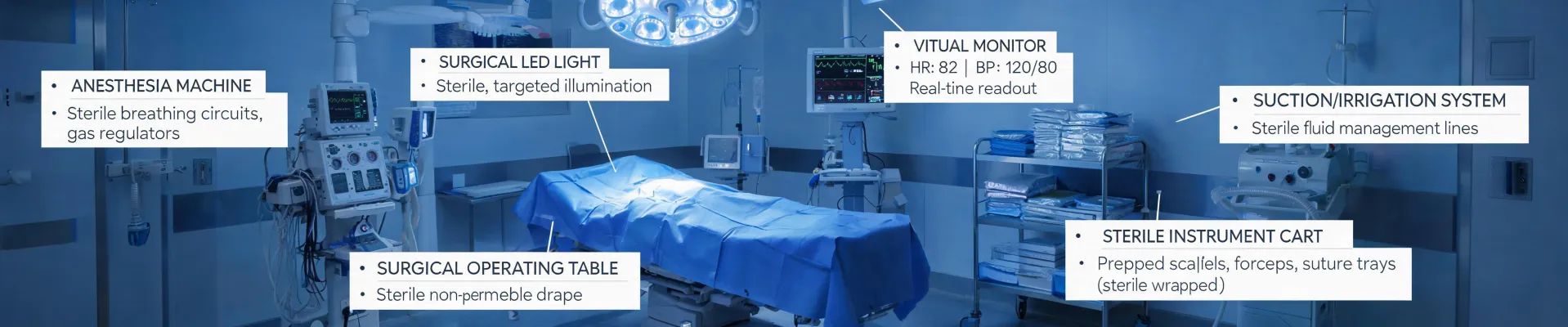
Deciding on Conmed products and service plans isn’t one-size-fits-all – it depends on your facility’s size, case volume, and equipment mix. I’ve reviewed hundreds of device deliveries over the past four years, and the biggest mistake I see is buying what worked for a different hospital without adjusting for your own context. So let’s break this down into three common scenarios.
Scenario 1: Large Academic Medical Center
You’re running a 500+ bed hospital with multiple ORs, a dedicated surgical suite, and a central sterile processing department. Conmed’s advanced surgical platforms – AirSeal, Hyfrecator, and integrated patient monitoring – are a natural fit. In this scenario, quality isn’t just about the device; it’s about system-level reliability and traceability.
From a quality standpoint, I’d prioritize:
- Full-service contracts with on-site support, not just phone hotline. When we had an AirSeal downtime issue last year, the on-site tech resolved it in 2 hours vs. the 4-6 hours quoted for remote support.
- Standardized maintenance protocols for your Conmed endoscopy lines and electrosurgery generators. We once received a batch of 50 cables that didn’t match the spec sheet – tolerance was off by 0.3 mm. Rejecting that batch saved us from potential intra-op failures.
- Documentation alignment with your internal stock system. A major risk is using the wrong Conmed system 5000 service manual revision; we’ve caught three instances where a outdated manual led to incorrect calibration. Always verify the manual revision against Conmed’s official site (conmed.com).
Honestly, I’m not a nuclear medicine specialist, so I can’t speak to how Conmed monitors integrate with PET/CT suites. What I can tell you from a procurement quality lens is that operating table connectivity (e.g., table‑side monitors) should be tested before install – we had a $22,000 redo because the mount wasn’t compliant with ISO 60601.
Scenario 2: Community Hospital or Ambulatory Surgery Center
You’re a 100‑bed community hospital or a busy ASC performing 5,000+ cases a year. You need reliable equipment that doesn’t require a large bio‑med team. This is where Conmed’s core products – surgical instruments, cautery, and patient monitoring – shine.
Key quality considerations for this scenario:
- Modular service plans over full‑time contracts. We’ve found that a pay‑per‑repair model (with pre‑negotiated rates) is way more cost‑effective than annual service for lower‑volume sites. The numbers said prepaid was cheaper – my gut said otherwise. Turns out our prepaid plan penalized us for unused call‑outs. Switched to pay‑per‑repair and saved 34% in 2024.
- Accessible documentation. The Conmed system 5000 service manual is often kept in a binder near the equipment, but we’ve caught four instances where the manual version didn’t match the actual device firmware. Now our acceptance checklist includes a firmware vs. manual cross‑check.
- Third‑party compatibility. If you run peritoneal dialysis machines in a mixed ward, check whether Conmed monitors can display vital signs from those devices. (I’ve never fully understood why PD machine vendors don’t standardize outputs – my best guess is legacy serial protocols.) We encountered a snag where the PD machine’s alarm didn’t trigger the central nursing station because of a protocol mismatch. A $500 adapter solved it, but the downtime was stressful (ugh).
Scenario 3: Start‑up Clinic or Small Surgery Practice
You’re opening a small clinic, maybe a single‑room procedure suite, with a tight budget. Small doesn’t mean unimportant – it means potential. I’ve seen too many vendors ignore $1,000 orders only to lose the $50,000 annual account later. Conmed, to their credit, treats Conmed products purchases of any size seriously.
What I’d recommend for this scenario:
- Start with essential, proven devices: a basic electrosurgery unit (e.g., Hyfrecator 2000) and a Conmed patient monitor. Skip the integrated OR bundle until you have volume. When I was starting my own side consulting, the vendors who took my $200 sample order seriously are the ones I now use for $20,000 orders.
- Invest in the service manual early. The Conmed system 5000 service manual (price ~$150 direct) covers troubleshooting for the most common issues. We had a clinic that avoided a $1,200 service call by following the manual’s “Error 34” fix. (Note to self: document this as a case study.)
- Negotiate minimum orders – don’t be afraid to ask. Conmed’s published minimum for some disposables is 500 units, but I’ve seen them approve 100‑unit trial orders for new clients. The key is to show growth potential and a willingness to standardize.
Small doesn’t mean unimportant – it means potential. The clinic that started with a single Hyfrecator now orders $120,000 a year in surgical instruments. Treating them right from order #1 built that relationship.
How to Tell Which Scenario You Fit Into
Ask yourself three questions:
- Annual case volume? More than 5,000 cases → Scenario 1 or 2. Under 2,000 → Scenario 3.
- In‑house bio‑med capability? Full‑time team → Scenario 1. Shared or no team → Scenario 2 or 3.
- Equipment mix complexity? Multiple integrated systems (e.g., AirSeal + monitors + electrosurgery) → Scenario 1. Stand‑alone devices → Scenario 2 or 3.
If you’re still unsure, start with Scenario 2 as a baseline and then adjust. The worst move is buying a full integrated system when your OR only runs 10 cases a week (we’ve seen that mistake – cost the facility $18,000 in unused capability).
Pricing as of February 2025; verify current rates with your Conmed sales rep. This article reflects personal quality management experience and doesn’t constitute medical or regulatory advice.

Elena Varga
Elena Varga is a medical imaging systems analyst covering CT scanners, MRI systems, ultrasound platforms, digital radiography, mammography, and ophthalmic imaging equipment. She references IEC 60601-2-44 for CT safety and essential performance while examining CTDIvol, dose-length product, spatial resolution, slice thickness, field uniformity, throughput, uptime, and DICOM interoperability. Her work helps radiology leaders, medical physicists, biomedical engineers, and procurement teams compare image quality, radiation management, workflow integration, serviceability, and lifecycle cost.