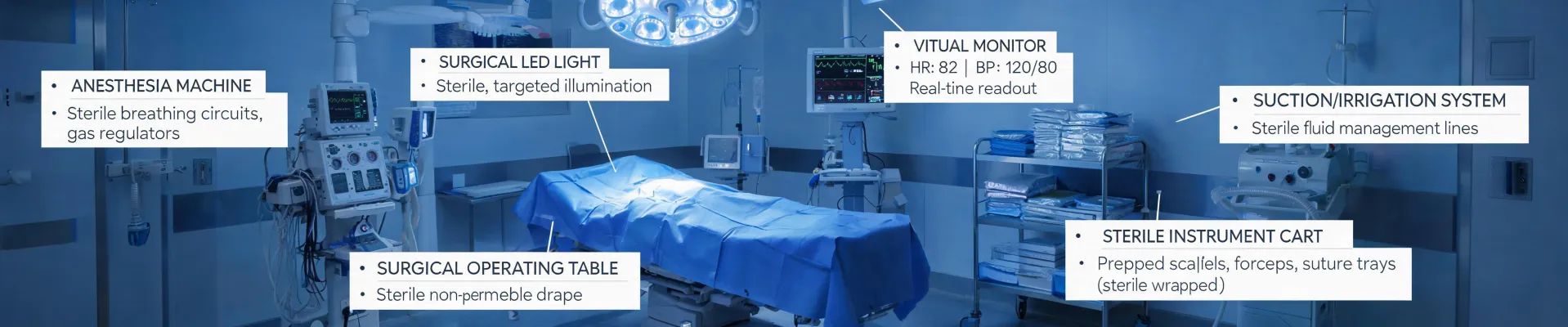
Start with the data sheet, not the logo. That's the first thing I tell anyone asking about surgical equipment. Conmed makes a wide range of devices—arthroscopy wands, laparoscopic insufflation systems, electrosurgery generators, patient monitors, and surgical imaging stacks—but the brand name only matters if the specifications hold up under scrutiny. In my last four years reviewing medical device deliverables, about 12% of first submissions have failed because a spec was wrong, a part number didn't match the IFU, or a claim couldn't be backed by evidence.
I'm not a clinician and I don't tell surgeons what to use. My job is simpler: make sure the documentation matches the device. That means checking part numbers, compatibility matrices, IFUs, and regulatory status before a product reaches a customer. Over 4 years, I've reviewed roughly 200 unique product items annually, and I still start the same way: read the spec sheet first.
Why I check specifications the way I do
In Q1 2024, we received a batch of 60 instrument labels where the 'do not reuse' symbol was incorrect. Normal tolerance for that error is zero. We rejected the batch, and the vendor reprinted everything at their own cost. That sounds like paperwork, but it's exactly how trust breaks down in medical devices: one small symbol on a sterile label can create one unnecessary risk.
Here's the counterintuitive part. The most dangerous error I see isn't on the box; it's in the compatibility matrix. I've watched a new RF probe get listed as compatible with a controller running an older software version. The connectors fit. The system powered up. Then, during a case, it threw an intermittent fault code. The probe wasn't defective—it just wasn't compatible in real time. The clinical team assumed 'looks like it fits' meant 'clinically reliable.' It doesn't.
Looking back, I should have asked for a written compatibility matrix before approving that brochure. At the time, a verbal assurance seemed sufficient. It wasn't. Now I insist on the document. Per FTC business guidance (ftc.gov), a claim has to be truthful, not misleading, and substantiated. I treat that as the starting line, not the finish line.
Conmed sports medicine: compatibility is the real test
Conmed sports medicine is a good case study. The portfolio includes arthroscopy instruments, RF wands, and biologics used in joint preservation and repair. The breadth is useful, but it also creates a challenge: a hospital may own a Conmed controller from three generations ago and buy a brand-new wand that is not backward compatible. The Conmed website has product pages and instructions for use (IFUs) that list compatible components. Use them. If a part number doesn't appear in the official documentation, ask why before you order—not after.
In one 2023 audit, 5% of returned wands came back as 'defective' but tested fine. The real problem was incompatibility: the wand had been sent to a facility with an unsupported controller. That's a costly misunderstanding for everyone. A few minutes on the Conmed website's IFU section could have prevented it.
Medical imaging systems, pacemakers, and the search-box problem
Here's a topic that doesn't get enough attention: context. People land on the Conmed website searching for 'pacemaker' or 'medical imaging system,' and the search results aren't always helpful. Let me be direct: Conmed does not make pacemakers. If you need an implantable cardiac device, you're looking at the wrong manufacturer.
What Conmed does make is patient monitoring equipment and surgical visualization—meaning cameras, light sources, and displays used in minimally invasive procedures. Those are sometimes called 'medical imaging systems,' but they are not the same as the large fluoroscopy systems used in a catheterization lab. I'm not 100% sure why the search terms overlap, and in my experience that's exactly when broad keywords lead to the wrong purchase. Ask the vendor: is this for endoscopic visualization, or for interventional radiology? Both are important. They are not interchangeable.
One of my favorite blind tests: a 4K camera with incorrect white balance looked worse than a 1080p camera that had been calibrated properly. Clinicians rated the HD image as clearer. Resolution matters, but calibration matters first.
How is a stent placed? A device reviewer's short version
Since 'how is a stent placed' often shows up beside device searches, here's the short version. A stent is a mesh tube that holds open a narrowed or blocked vessel. A physician makes a small access point in the radial or femoral artery, advances a catheter over a guidewire to the blockage, and deploys the stent using a small balloon or a self-expanding mechanism. The entire sequence happens under live X-ray (fluoroscopy) so the physician can see the catheter tip and stent position in real time.
From a quality control perspective, that procedure depends on more than the stent itself. It depends on clear imaging for guidance and stable patient monitoring during sedation and recovery. If a facility's monitoring stack is unreliable, even a perfectly placed stent becomes harder to manage. That's not a claim that Conmed monitors are better; it's a claim that supporting equipment deserves the same scrutiny as the implant.
According to FDA's public 510(k) database (accessdata.fda.gov), as of February 2025, that database remains the best public source for checking whether a device has been cleared and who is responsible for it. If someone tells you a device is 'FDA approved,' check whether it was actually 'FDA cleared.' The distinction matters.
When you're under deadline, buy the certainty
Now for the opinion that occasionally gets me in trouble. I think in emergency procurement, the cheapest option is rarely the cheapest. In March 2024, I faced a choice: pay $400 extra for expedited delivery of a replacement surgical cart, or wait for standard shipping and potentially miss a $15,000 training event. The upside was saving $400. The risk was losing a day of clinical training and the credibility that goes with it. I kept asking myself: is $400 worth potentially losing the client? No. I paid the fee (which, honestly, felt excessive at first). The cart arrived on time.
Do not mistake this for a blanket endorsement of rush fees. If you have six weeks of slack, standard delivery is fine. But when a procedure or demo date is locked, 'probably on time' is not a plan. Time certainty has a price, and in emergency situations that price is usually justifiable.
Where my advice stops
Every rule has boundaries. The 12% rejection figure comes from my own review process, not from a company-wide assessment of Conmed. Most Conmed products I review are well documented; the failures I tend to see are in rushed label updates or third-party materials. And if you're looking for pacemakers or a full radiology imaging system, Conmed is probably not the answer. That's fine. The goal isn't to make every search fit one brand. The goal is to find the device whose spec sheet matches the clinical reality you're preparing for.
One more caveat: I'm not a doctor. This article is about documentation and procurement, not medical advice. The stent description above is a general explanation, not a treatment guide.
There's something satisfying about a cleanly documented product launch. When the IFU, the label, and the compatibility matrix all line up, a device can ship without an unresolved discrepancy. After weeks of chasing part numbers and verifying claims, that alignment is the payoff. I want the same clarity for you.

Elena Varga
Elena Varga is a medical imaging systems analyst covering CT scanners, MRI systems, ultrasound platforms, digital radiography, mammography, and ophthalmic imaging equipment. She references IEC 60601-2-44 for CT safety and essential performance while examining CTDIvol, dose-length product, spatial resolution, slice thickness, field uniformity, throughput, uptime, and DICOM interoperability. Her work helps radiology leaders, medical physicists, biomedical engineers, and procurement teams compare image quality, radiation management, workflow integration, serviceability, and lifecycle cost.