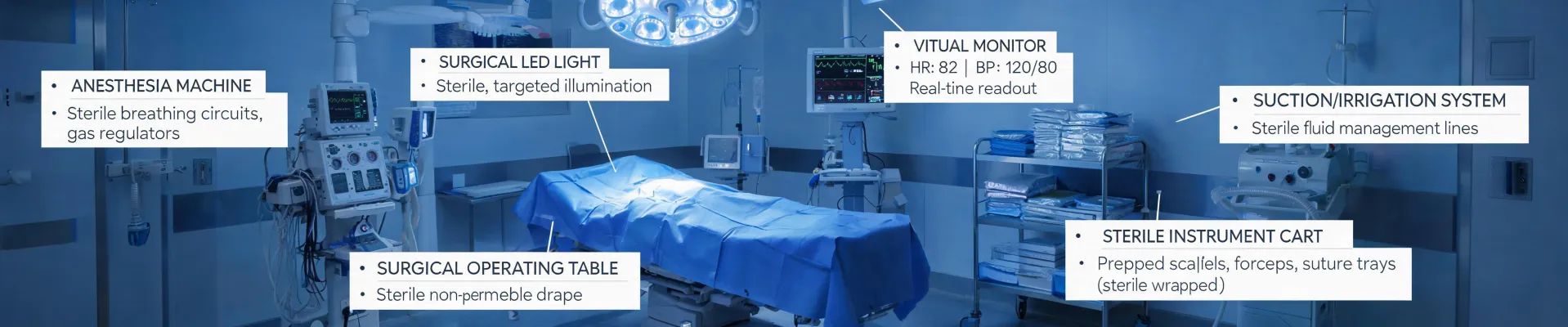
Setting Up the Comparison: Conmed vs. The 'Other Guys'
When you're tasked with sourcing for a new OR suite or upgrading an existing one, the conversation almost always comes down to a few big names.
And Conmed is usually right there in the mix—especially if you're looking at advanced surgical products like laparoscopic instruments, endoscopic systems, or electrosurgical generators.
But here's the thing: a straight-up 'Conmed is best' article isn't helpful. You need to know when Conmed makes sense and when you might be better off looking elsewhere.
I'm not a sales rep. I'm the guy who's been handling equipment procurement for a mid-sized hospital network for about 5 years now. I've made my share of mistakes—including a $3,200 order for the wrong spec'd catheters because I assumed the model number meant the same thing across vendors. That one still stings.
So, let's break this down across three key dimensions: Product Breadth & Compatibility, Service & Support Responsiveness, and Total Cost of Ownership.
Dimension 1: Product Breadth & Compatibility
Conmed's Approach: The Integrated Ecosystem
Conmed's strength is their focus on specific surgical disciplines. Their advanced surgical products aren't a grab bag of random stuff. They've built a cohesive ecosystem around minimally invasive surgery.
For example, their Conmed System 2450 and System 5000 electrosurgical generators are designed to integrate seamlessly with their laparoscopic instruments and endoscopic cameras. This isn't an accident.
From what I've seen, this integration reduces setup time and technical glitches. When everything in the tower speaks the same language, the OR staff spends less time troubleshooting and more time on the patient.
The General Alternative: Mix-and-Match Modularity
A common alternative is to buy from a broader distributor or piece together a system from different specialists. You might get a Stryker camera, a Conmed cautery machine, and an Olympus scope.
This works. It's been the standard for decades. But it brings a hidden cost: compatibility headaches. I remember a case where an older ECG vs EKG monitoring cable from one brand didn't play nice with the new electrosurgical unit from another. The interference was terrible. That was a 'figure it out in 15 minutes before the case starts' kind of morning.
The big advantage of the mix-and-match approach? If one component fails, you can swap it out without being locked into a single vendor's supply chain. You've got flexibility.
So, What's My Verdict?
For new OR builds or major upgrades, Conmed's integration is hard to beat. It reduces complexity. But if you're managing a legacy fleet of equipment from different eras, the flexible approach might be your only realistic option.
Here's a counterintuitive point: Conmed's focus means they don't make everything you need. They won't sell you a patient bed or an MRI machine. Some buyers see this as a limitation. I see it as a green flag. The vendor who says 'this isn't our strength—here's who does it better' earns my trust for everything else. The 'one-stop-shop' promise is often a fantasy.
Dimension 2: Service & Support Responsiveness
Conmed's Approach: Specialized Support
Conmed has dedicated support teams for their product lines. When we had a problem with an AirSeal insufflator mid-case, their clinical support person was on the phone within 10 minutes walking us through a reset protocol. The rep even visited the next day to check in.
That level of clinical support is critical. Surgeons lose patience fast when equipment malfunctions.
The General Alternative: The Big Distributor Runaround
Going through a large distributor or buying from a conglomerate can be a different story. You call the main number, you get a call center, you're transferred three times. The person who finally answers might know the general product category but not the specific nuance of Conmed's laparoscopic instruments you're trying to use.
I wish I had tracked our call resolution times more carefully. What I can say anecdotally is that our average wait time for a specialized answer from a big distributor was about 2.5 days. With Conmed, it was hours. This isn't a universal truth—just my experience over about 40-50 service interactions in the past 3 years.
Dimension 3: Total Cost of Ownership (TCO)
This is where most buyers make mistakes. They focus on the per-unit cost of an IV catheter or the price tag on a patient lift system.
Upfront Costs
Conmed's capital equipment—like their System 5000 generator—isn't cheap. It's priced competitively with other premium brands. You're not getting the bargain-bin option.
The Hidden Costs of Going Cheap
Here's the trap. You can get a cheaper electrosurgical generator from a no-name brand. The upfront cost is maybe 30% less. But: what happens when it needs service? Are replacement parts available? Can you get a loaner unit during repairs?
We had a situation with a cheaper unit where a critical component failed. The manufacturer wanted us to ship the whole unit back for repairs. Estimated turnaround: 3 weeks. In that time, we had to borrow a Conmed unit from a sister hospital, which worked flawlessly. The 'savings' on the cheap unit evaporated.
Had our staff 3 hours to decide before a big case list. Normally I'd do a full TCO analysis with lifecycle costing. But with that surgical schedule looming, I went with the Conmed unit based on trust and prior experience. Looking back, I should have done that analysis sooner. But given what I knew then—zero confidence in the cheap vendor's support—it was the right call.
So, What's the Real Cost?
Conmed's total cost, including purchase, training, and support, tends to be predictable. The lower upfront cost of an alternative can look good on a P&L sheet for one quarter. But if you factor in downtime, service headaches, and potential for re-purchases, Conmed often comes out ahead—especially for high-utilization, critical-path equipment like electrosurgery and endoscopy.
Around $15,000 saved on a generator purchase—no, $12,000, I'm mixing it up with a different capital purchase from last year. It was substantial, but the downtime cost us more in lost OR time.
Final Recommendation: What Should You Do?
There's no one-size-fits-all answer. Seriously. It depends on your specific situation.
Choose Conmed when:
- You're equipping a new OR. The integration and single-source support simplify everything.
- Your surgeons are already using their instruments. Compatibility is guaranteed.
- You need reliable support for complex cases. Their clinical support team is a differentiator.
- You value a predictable TCO over a lower initial price. The long-term costs are clearer.
Consider alternatives when:
- You need a single item (like a specific IV catheter), and a backorder on a Conmed part forces you to find a reliable substitute. Their website, the Conmed official website, is useful for checking stock but doesn't always tell the full story.
- Your system is already built around another vendor's ecosystem. Full rip-and-replace is rarely economical.
- Your budget is extremely tight and you can afford the risk of slower support. This is a business decision, not a technical one.
- You need a very specific feature that Conmed doesn't offer. Remember, they focus on their core strengths.
The bottom line? Don't buy equipment based on brand loyalty alone. Map your needs—clinical workflow, support expectations, and your risk tolerance for downtime—to the vendor's strengths. That's how you avoid the mistakes I made my first year.

Jane Smith
I’m Jane Smith, a senior content writer with over 15 years of experience in the packaging and printing industry. I specialize in writing about the latest trends, technologies, and best practices in packaging design, sustainability, and printing techniques. My goal is to help businesses understand complex printing processes and design solutions that enhance both product packaging and brand visibility.