The search started in Q4 2024, buried under a pile of budget spreadsheets. My boss dropped a requisition on my desk for two new patient monitors in our step-down unit. Simple enough, right? We'd been buying the same model for six years. The clinical team liked them, biomed knew how to fix them, and the price was in our comfort zone.
But then I started digging into the actual numbers for our annual capital equipment review. That's when I realized we'd been having the wrong conversation. We thought we were buying a box that shows vital signs. We ended up redesigning our entire surgical workflow.
Here's the thing that surprised me: the thing I thought was a simple replacement turned out to be a gateway. Because while comparing the latest Conmed patient monitor specs (which, honestly, are impressive on paper), I had to ask a few questions our team had never considered. And those questions led us down a rabbit hole that involved our entire perioperative services line.
The Original Problem: A Simple Refresh
The initial request was straightforward. Our step-down unit's monitors were hitting their end-of-life cycle. The failure rate had crept up from 2% to 9% over the last two years. The clinical engineers were spending more time patching old systems than they were doing preventative maintenance. It was time to refresh.
My first instinct was to just replicate. Find the same model, negotiate a volume discount, place the order. It was the path of least resistance. But our procurement policy, which I built after getting burned on hidden fees twice (note to self: that policy has saved us roughly $40,000 in three years), forced me to compare at least three vendors and consider TCO, not just sticker price.
That policy is annoying sometimes. But it's the reason I caught this.
The Discovery: It's Not About the Box on the Wall
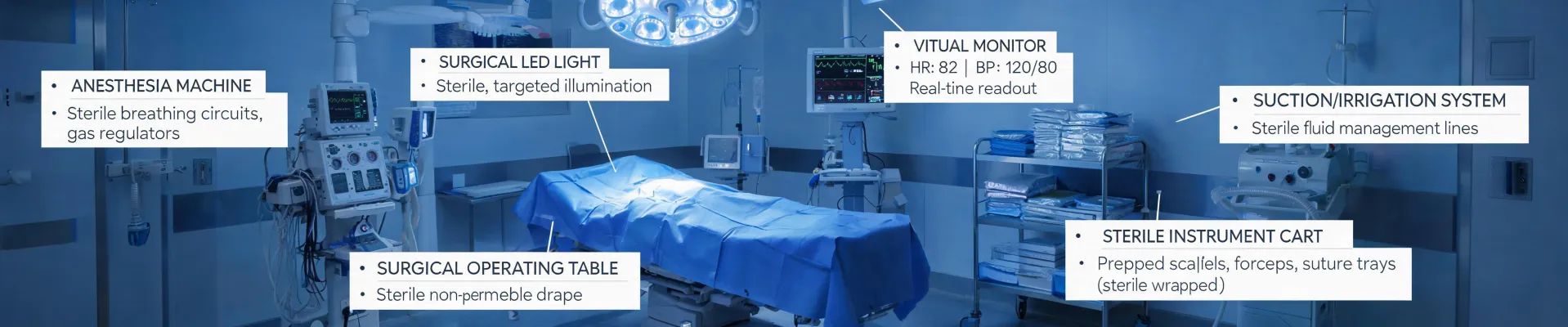
As I mapped out our asset lifecycle, I noticed something odd. We were maintaining three separate systems in our OR suites that were all doing overlapping jobs. We had the older patient monitors in pre-op. We had a separate sleep diagnostic device being trialed for post-surgical respiratory monitoring. We had our main anesthesia machines telling us one thing while the standalone C-arm system (which we'd leased, by the way, at a premium) was giving us a different set of imaging data.
It was a mess. Each piece functioned alone, but they refused to talk to each other. Nurses were manually transcribing data from one screen to another. That's a process gap that costs us in two ways: wasted time (which is money) and transcription errors (which is risk).
I remember sitting in the surgeon's lounge with Dr. Ellis—she's the medical director for the OR—and asking her, "What's the ideal state?" She looked at me like I was speaking a foreign language. Then she said, "I want to see the patient's status from pre-op, through the procedure, and into recovery, without having to physically walk to three different stations to get it."
The Turning Point: Total Cost of Ownership (TCO) vs. Sticker Price
That conversation flipped my cost analysis upside down. I stopped focusing on the patient monitor price tag and started looking at the workflows. What I found was a hidden budget drain that we'd been ignoring for years—the classic pitfall of focusing on the unit cost instead of the integrated system.
Here's a breakdown of the comparison I did for our board last January:
- Option A (The "Cheap" Refresh): Buy the same monitors, keep our fragmented workflow. Cost: $120,000 for devices, plus the $30,000 we were already spending annually on manual data transcription errors and inefficiencies.
- Option B (The Integrated System): Invest in Conmed's advanced surgical platform, which connects the patient monitor data with the AirSea system and our electrosurgery units. This meant consolidating vendors and rebidding for an upgraded C-arm system to ensure imaging data flowed into the same ecosystem. Cost: $185,000 for the hardware, but it eliminated the manual transcription roles and allowed a 15% reduction in average OR turnover time (which, for a facility that does 1,200 cases a year, is a massive capacity gain).
I have mixed feelings about the upfront premium. On one hand, $65,000 is real money. On the other hand, the Phase 2 analysis showed we would recoup that difference in less than 14 months just from the turnover time savings. The question isn't "What's the price?" It's "What's the cost of doing nothing?"
What About the Hospital Bed and the Sleep Device?
I know the search terms that brought you here probably weren't just about patient monitors. You're looking at the whole puzzle—trying to figure out what the modern hospital looks like in 2025.
Let me tell you how the story connects. The average hospital bed is no longer just a piece of furniture. When we integrated our monitoring platform, we found that our smart beds (which we'd purchased two years ago) could actually feed vital data into the same system we were installing. We had paid for the capability but never enabled it because no one had thought to connect the dots.
Similarly, the sleep diagnostic device we were trialing for at-home pre-surgical screening gave us a baseline respiratory data set. That data is now flowing into the patient's electronic record, providing anesthesiology with a richer picture than we ever had before. The devices weren't the problem. The silos were.
Here's a valid point: much of what we call "new technology" is actually just us finally taking advantage of existing, unconnected capabilities. It's not about buying the fanciest equipment. It's about creating an ecosystem where they all work together.
The Result & The Lesson
We rolled out the integrated system in March 2025. The process wasn't perfect—we underestimated the biomed training time by about a week (ugh), and we hit a hiccup with the IT networking permissions that took three days to untangle. But the results speak for themselves.
In the last two months, our pre-op to closure time is down by about 11%. The nurses are actually happy because they're not playing data-entry clerk anymore. And the finance department is smiling because the overtime hours in the OR have dropped by 30%.
There's something satisfying about a process that finally works. After all the meetings, the spreadsheets, and the vendors trying to upsell us, the payoff is seeing a surgical team actually trusting the data in front of them.
What was best practice in 2020 would have been to buy the cheapest monitor that met the basic specs. In 2025, that's a trap. The device is a node in a network, not a standalone tool. If you're looking at a patient monitor, or a C-arm system, or even a hospital bed, don't ask "Is this a good product?" Ask "Does this make our entire system better?" The fundamentals of good procurement—paying attention to total cost, not unit cost—haven't changed. But the execution has transformed.
"We thought we were buying hardware. We were actually buying a workflow redesign." — the author, after the board meeting.
If you're in the middle of a similar capital budget review, my advice is this: don't let the vendor's spec sheet drive the purchase. Let your clinical workflow drive it. Look at the patient monitor, but then look at the C-arm, the sleep diagnostic device, and even the powered beds. They're all part of one system. If you're not buying for the system, you're paying for a $1,200 redo when quality fails—or worse, a $120,000 paperweight because the device doesn't talk to your EMR.

Elena Varga
Elena Varga is a medical imaging systems analyst covering CT scanners, MRI systems, ultrasound platforms, digital radiography, mammography, and ophthalmic imaging equipment. She references IEC 60601-2-44 for CT safety and essential performance while examining CTDIvol, dose-length product, spatial resolution, slice thickness, field uniformity, throughput, uptime, and DICOM interoperability. Her work helps radiology leaders, medical physicists, biomedical engineers, and procurement teams compare image quality, radiation management, workflow integration, serviceability, and lifecycle cost.