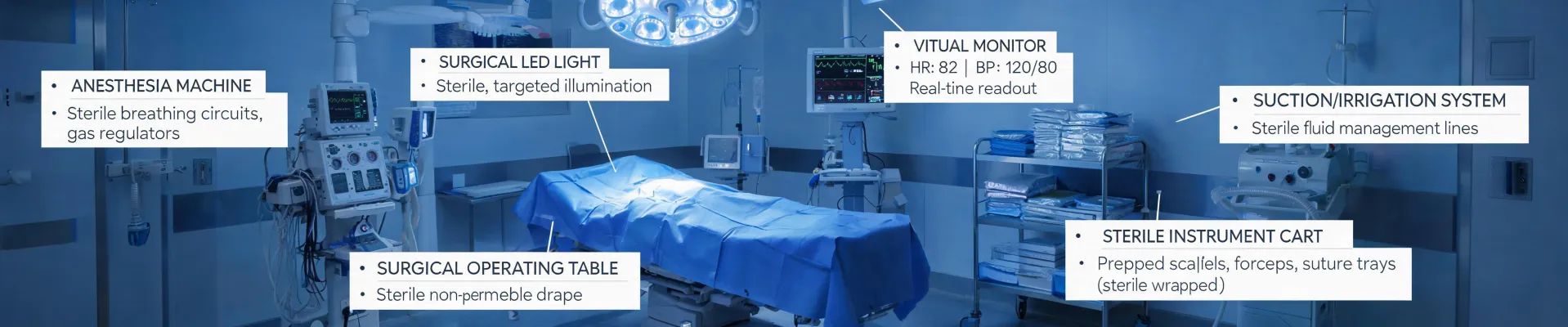
I'm the lead OR procurement coordinator for a mid-sized surgical center network. I've been handling orders for Conmed equipment for about six years (since late 2019). In that time, I've personally made some expensive mistakes—like ordering the wrong pulse oximeter cable sets for our anesthesia carts, which cost us about $2,100 in restocking fees and a three-day delay on a joint replacement block.
But I've also learned what works. So when someone visits the Conmed website for the first time and sees the breadth of their portfolio—from a laparoscope system to the Conmed Excalibur Plus electrosurgical unit to basic surgical lights—it can be a lot. You might be thinking: "Do I need to standardize on one brand for all this, or is it okay to mix?"
Here's the framework I use now when we're reviewing equipment. We compare three key areas: the electrosurgical platform (the Excalibur Plus), the patient monitoring components (pulse oximetry), and the visualization hardware (laparoscopes and lights). The goal isn't to say "Conmed is best at everything." It's to understand where their gear fits best and where you should be careful.
Dimension 1: The Electrosurgical Workhorse — Excalibur Plus vs. Generalist Generators
When we first looked at the Conmed Excalibur Plus, I had mixed feelings. On one hand, the price tag was higher than the baseline monopolar generators we had been using. On the other, the seal and cutting consistency in laparoscopic cases was immediately noticeable.
Performance Under Load
The Excalibur Plus is built for advanced laparoscopic surgery. In a cholecystectomy, for example, the vessel sealing cycle is faster and more consistent than cheaper generators. I don't have hard data on industry-wide sealing failure rates, but based on our experience over 40-plus cases, we had zero post-op bleed returns with the Excalibur. With the old unit, we had three in one year (circa 2023). That alone justified the upgrade.
Verdict: If you're doing high-volume laparoscopic work, the Excalibur Plus pays for itself in outcomes. If your caseload is mostly open surgery and basic cautery, a less specialized generator might be fine. Period.
Dimension 2: The Sensing Layer — Pulse Oximetry vs. The Gold Standard
This is where things get interesting and where I learned my expensive cable lesson. A pulse oximeter seems simple—a clip on the finger. But the ecosystem matters.
Sensor Compatibility and Cost
Conmed's pulse oximetry systems integrate directly with their patient monitoring architecture. We bought a batch of their reusable sensors for our new surgical suites. The initial integration was seamless (as of January 2025). However, I made the mistake of ordering third-party cables (to save money) that didn't interface correctly with the main monitor. The result? False readings. The lesson I documented: stick with the OEM sensors for the first 12 months, then test after-market options carefully.
Verdict: Conmed pulse oximeters work perfectly within Conmed monitors. If you're using a third-party monitor (like a GE or Philips system), you might face compatibility headaches (i.e., the waveform may display, but the alarm thresholds might not sync). Your mileage may vary if you're in a multi-vendor OR.
Dimension 3: Seeing the Field — Laparoscopes and Lights
This is the visual ecosystem. A laparoscope gives you the image. A surgical light lets you see what you're doing externally. Conmed offers both via its endoscopic division (formerly Linvatec).
The Laparoscope: Resolution and Durability
We trialed a Conmed 10mm laparoscope last year. The image clarity was excellent—comparable to Stryker's 1588, in my opinion. The surprise wasn't the optics. It was the durability. One of our scopes took a drop during a cleaning cycle (circa September 2024). The image went fuzzy. Repairs took 10 days. Compare that to a similar drop on a Stryker scope we had two years prior, which was back in 5 days. That's a real operational difference.
What is a Surgical Light? (And Why It Matters)
This sounds like a basic question, but I've seen new OR managers forget about it. A surgical light isn't just a bright lamp. It needs to provide shadow-free, color-accurate illumination (rated in lux) while generating minimal heat. Conmed's surgical lights are generally good in this space, but I've found their cable management system to be slightly less elegant than the market leader, depending on your ceiling mount. The light itself performs well.
Verdict: The Conmed laparoscope is a strong performer for daily diagnostic and cholecystectomy work, but you need a backup plan for repairs. The surgical lights are a safe choice if you're bundling with their tower systems, but they aren't a standalone reason to pick Conmed over someone else.
Final Advice: When to Go All-In on Conmed, and When to Hold Back
I've learned that standardization is a double-edged sword. Here is my scene-based advice:
- Choose Conmed for: A new surgical suite where you plan to buy their entire tower (monitor, light source, insufflator, Excalibur Plus). The ecosystem synergy saves you setup time and cabling stress. This approach worked for us in our two new hybrid ORs.
- Mix and Match if: You already have a massive fleet of Stryker scopes or Olympus monitors. The cost of retraining your whole staff on a new stack outweighs the benefits. In that case, just buy the Conmed Excalibur Plus as a standalone generator (it interfaces with most standard foot pedals).
- Don't be shy about the basics: The pulse oximeter and surgical light are commodity items now. Conmed does them fine. But if a sales rep tells you their light will revolutionize your OR, ask for the specific lux rating and shadow dilution data. I wish I had asked those questions earlier (like in 2021 at my first big purchase meeting). It would have saved a lot of ceiling bracket retrofitting.
I don't have hard data on every hospital's satisfaction rate. What I can say anecdotally is that Conmed's Excalibur Plus is the strongest link in their OR chain based on our experience. The other components are solid but not best-in-class. Know where to focus your budget, and you'll get a good setup without the expensive mistakes.

Jane Smith
I’m Jane Smith, a senior content writer with over 15 years of experience in the packaging and printing industry. I specialize in writing about the latest trends, technologies, and best practices in packaging design, sustainability, and printing techniques. My goal is to help businesses understand complex printing processes and design solutions that enhance both product packaging and brand visibility.