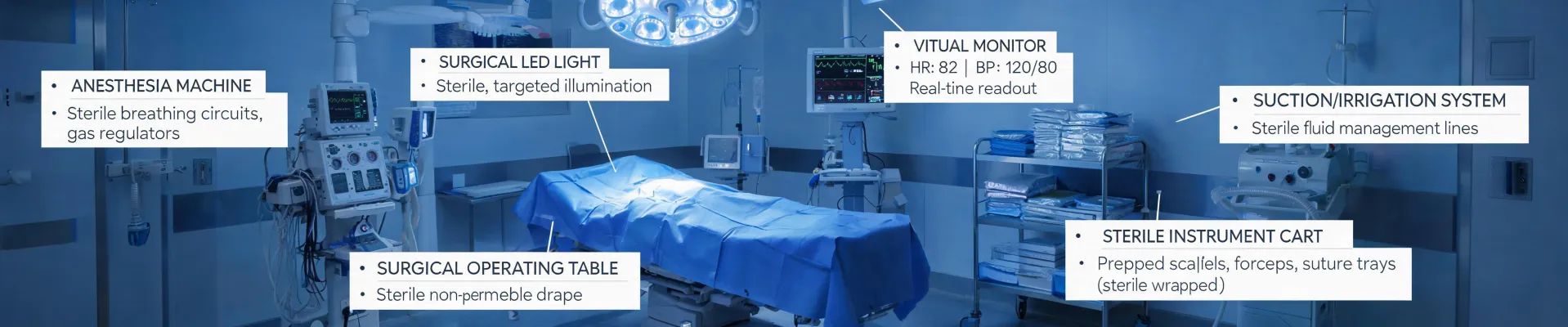
The email came through on a Tuesday in March 2024. Subject line: 'OR 2 Approval.' We were getting a second operating room. My first reaction was relief—we'd needed the capacity for a year. My second reaction, honestly, was a quiet 'oh no.' Because an OR is not just a room with a table. It's a puzzle of instruments, monitors, suction, anesthesia, and a hundred small things that all have to agree with each other.
What I mean is that an OR buildout is not a shopping list. It's a system. The video tower, the insufflator, the electrosurgery generator, the patient monitors, the anesthesia machine, and the suction all have to work as one. If you only compare unit prices, you'll miss the part where one device can't talk to another.
I'm the purchasing coordinator for a 40-bed outpatient surgical center. I manage equipment and supply ordering—roughly $1.8 million annually across about 14 vendors. I report to both operations and finance. When I took over purchasing in 2020, I learned the hard way that a low price means nothing if the vendor can't invoice properly. One bad vendor cost us $4,700 in rejected expenses. So I've got a rule: verify before you commit. This project tested that rule in ways I didn't expect.
The Conmed Laparoscopic Instruments Were the Easy Part
The surgeons were actually the easy part. They had used Conmed laparoscopic instruments at the hospital across town and wanted the same kits here. No pushback. We arranged a week-long demo, and the clinical team put them through a couple of taped cases. The instruments felt balanced, the handles didn't fatigue the residents, and the AirSeal insufflation system was the feature everyone kept mentioning. I can't do the clinical explanation justice, but from a buying perspective, the surgeons were sold. I ordered the core set: graspers, scissors, dissectors, clip appliers, and the electrosurgery components that go with them.
Before that order went in, I checked the FDA clearance status for anything that required a 510(k). It's not a full substitute for a clinical evaluation, but it's the baseline. If it's not cleared, it doesn't go in our building.
The Anesthesia Machine, the Monitor, and the Discount That Almost Was
The tricky part was the peripheral equipment. We needed a patient monitor for recovery and another for the pre-op area. The logical choice was a Conmed patient monitor, because we'd already standardized the vitals carts around them. The nurses didn't need retraining, and the existing telemetry integration was stable.
Then there was the anesthesia machine. We don't have a Biomed team on site, so any new capital equipment has to be reviewed by a contracted biomedical engineering consultant. That consultant is a hero, though I didn't appreciate it until later. We received three quotes. One manufacturer offered a bundle: anesthesia machine plus patient monitor plus integrated suction unit, all for about $12,000 less than buying separately.
That format is tempting. If you've ever had to show finance a spreadsheet with three quotes, you know how good a lower number looks. We almost signed. Big mistake.
What Is a Medical Suction Unit, Really?
Here's the part where I embarrass myself a little. When the project manager asked what suction we were planning, I nodded and said we'd get a medical suction unit. He asked which type. I had this vague picture of a small machine on wheels. It turns out 'medical suction unit' is an umbrella term, and the details matter more than I could have guessed.
I'm not a biomedical engineer, so I can't speak to the airflow curves and vacuum regulation specs. What I can tell you from a purchasing perspective is that not all suction is the same. There are portable units, wall suction installations, and surgical suction carts. They serve different purposes, and they're not interchangeable. It's tempting to think a patient monitor is a patient monitor, too. It's not. The differences are in the data.
Our biomedical consultant pulled up the ISO 10079 standards and asked the bundle rep one simple question: Which class does your integrated suction meet? The rep said he'd get back to us. That was the moment the deal started to fall apart.
He never did get back to us with a clear answer. Instead, he pointed to a line in the specs that said 'suction pump included.' To me, that's a red flag. A pump that can handle a quick oral suction is not the same as a pump that can support a surgical procedure.
We put the PO on hold. I spent the next two days reading spec sheets and calling other reps. The bundled patient monitor turned out to be a basic model with a nicer-looking display. It didn't integrate with our existing Conmed patient monitors, so the nurses would have had to learn a different interface and the data wouldn't flow into the same charting system. The anesthesia machine itself was fine, but the integrated suction didn't meet the requirement for continuous surgical use. The bundle was not a bargain. It was a downgrade wrapped in a discount.
Honestly, I'm not sure why the rep didn't mention the suction limitation. My best guess is that the sales incentive was behind the bundle, not the compatibility. Or maybe he just assumed nobody would ask.
What We Actually Bought
In the end, we bought: the Conmed laparoscopic instruments, a Conmed patient monitor for recovery, a different anesthesia machine without the integrated suction, and a standalone portable medical suction unit that met ISO 10079-1. The total came to roughly $12,000 more than the bundle would have cost.
But here's the math I ran for finance: if we had bought the bundle, we would have had to replace the monitor within a year, add a separate suction unit anyway, and pay the biomedical consultant to redo the integration. Estimated rework: $18,000, not counting the lost OR time while the room sat half-finished. $12,000 now versus $18,000 and a three-week delay later. That math was easy.
5 minutes of verification beats 5 days of correction.
Take it from someone who almost signed a bad PO: ask about integration. Ask about suction. Ask about the monitor's ability to talk to your existing system. Then ask the vendor to put it in writing. The Conmed laparoscopic instruments were the right call. The Conmed patient monitor was the right call. And the suction unit nobody wanted to talk about? That was the most important lesson of all.
The Lesson I Keep Relearning
It took me about four years and 90 equipment orders to understand that the 'best' device isn't always the one with the best price. Sometimes it's the one that plugs into the wall, connects to your monitors, and doesn't turn the OR into a construction site. Prevention is boring. It's a checkmark. It's a phone call to a biomed consultant. But in my opinion, it's the highest-ROI thing a purchasing person can do.
If you're about to spend a large portion of your annual budget on an OR buildout, trust me on this one: verify everything before you sign. The bundle that saves you twelve thousand dollars can cost you a lot more when you find out why it was cheap.

Elena Varga
Elena Varga is a medical imaging systems analyst covering CT scanners, MRI systems, ultrasound platforms, digital radiography, mammography, and ophthalmic imaging equipment. She references IEC 60601-2-44 for CT safety and essential performance while examining CTDIvol, dose-length product, spatial resolution, slice thickness, field uniformity, throughput, uptime, and DICOM interoperability. Her work helps radiology leaders, medical physicists, biomedical engineers, and procurement teams compare image quality, radiation management, workflow integration, serviceability, and lifecycle cost.