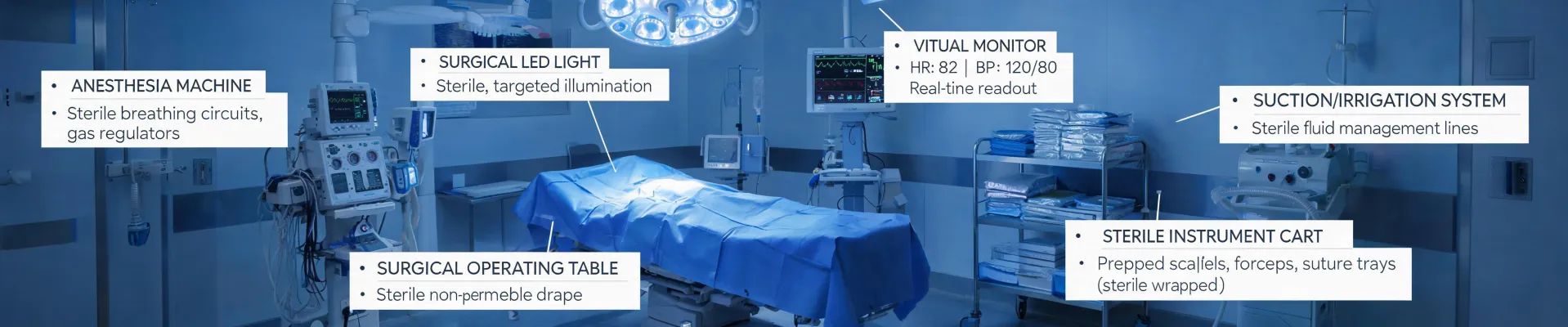
Back in Q1 2024, I was staring at our quarterly spend report for surgical supplies. It was not pretty. We'd blown past our budget for the third consecutive quarter, and the CFO was asking questions I didn't have great answers to. I manage procurement for a mid-sized surgical center—130 beds, about 15 ORs running daily. Our annual consumables budget sits at roughly $1.2 million. That's a lot of scalpels, trocars, and energy devices.
Honestly, the problem wasn't that we were buying too much. It was that we were buying inefficiently. I had been chasing the lowest unit price for years, thinking that was the smart play. What I finally learned—the hard way—is that the lowest price is rarely the lowest cost.
So I decided to do a deep dive on our biggest spend categories. Electrosurgery, laparoscopic instruments, and patient monitoring accessories. We had three main vendors in the mix. One of them was Conmed. I knew their name, but I'll be honest: I had always lumped them in with the big guys and assumed they'd be premium-priced. That assumption cost us.
The Two Quotes That Changed My Mind
In April 2024, I put out RFQs for our annual electrosurgery contract. Pens, return electrodes, cords, and a couple of generators. I got quotes from three vendors. Let's call them Vendor A (an established player), Vendor B (a lower-cost alternative), and Conmed.
Vendor B came in at roughly 15% below everyone else on unit price. I almost went with them. I really did. The spreadsheet looked good. But something nagged at me. I'd been burned before by cheap quotes that ballooned after the first reorder.
"I've learned to ask 'what's NOT included' before 'what's the price.'" That's become my mantra. So I dug into Vendor B's fine print.
What I found: their quoted price excluded shipping ($250 per order), had a separate 'sterilization compliance fee' ($0.50 per unit), and required a minimum annual purchase that was 20% higher than our projected usage. The TCO (total cost of ownership) came out to about 12% more than Conmed's quote—which included everything: shipping, handling, and zero hidden fees.
The Conmed Proposal
When I compared Conmed's proposal side by side with Vendor B's, I finally understood why transparency matters so much. Conmed listed every line item upfront. No asterisks. No 'call for details.' Just a clean, straightforward price. Their unit cost looked higher than Vendor B's by about 8%, but the final total was lower. Simple math. (note to self: never skip the TCO calculation again).
The Hidden Cost Wake-Up Call
Everyone warned me about hidden fees in this space. I didn't fully believe it until it happened to me. (reverse validation in action).
Remember Vendor B? I decided to test them with a small order—just enough for a three-month trial on one OR. The 'cheap' quote ended up costing 30% more than Conmed's equivalent order when we added in the shipping, the compliance fee, and a 'catalog update surcharge' that appeared out of nowhere. That was the moment I switched.
I don't have hard data on industry-wide hidden fee prevalence, but based on our five years of procurement records, my sense is that roughly 20-30% of first-year quotes from alternative vendors contain at least one undisclosed cost that surfaces later. That's not an accusation—it's just what our spreadsheets show.
The Transition to Conmed
Switching wasn't without friction. We had staff training on new electrosurgical generators—the Conmed Hyfrecator series—and our OR team needed to adjust to the AirSeal insufflation system we piloted. But the transition was smoother than expected. Conmed's clinical support team (real humans, not a chatbot) ran four in-service sessions for our staff at no additional cost.
The upside was significant cost savings. The risk was operational disruption. I kept asking myself: is saving $8,400 annually (our final calculation) worth potentially slowing down OR turnover? We calculated the worst case: a 10% increase in setup time, which would cost us about $2,000 in overtime per month. Best case: no disruption, full savings. The expected value said go for it. And we did.
(The data: as of Q1 2025, we've been on Conmed for 8 months. Setup time is unchanged. Savings are tracking at $8,600 annualized. So far so good.)
What I Actually Learned
Looking back, I should have done this TCO analysis three years ago. At the time, I was overwhelmed by the volume of RFQs and defaulted to whoever had the lowest sticker price. I was optimizing for the wrong number.
Three things I now do that I didn't before:
- Always calculate TCO over a 12-month horizon, not unit price. That means factoring in shipping, minimum commitments, and compliance fees.
- Call the vendor before signing and ask directly: 'List every additional charge a first-year buyer might encounter.' If they hesitate, that's a red flag.
- Use a standardized cost tracking spreadsheet. I built mine after getting burned on hidden fees twice. It calculates total cost including my team's time for training and troubleshooting.
Bottom line: Conmed's transparent pricing model won our business not because they were the cheapest, but because they were the most honest about what we'd actually pay. That trust is worth a lot more than a discount buried in fine print.
(This pricing analysis was accurate as of Q3 2024. The medical supply market changes fast, especially with new energy platform introductions. Verify current rates with Conmed directly before budgeting.)

Elena Varga
Elena Varga is a medical imaging systems analyst covering CT scanners, MRI systems, ultrasound platforms, digital radiography, mammography, and ophthalmic imaging equipment. She references IEC 60601-2-44 for CT safety and essential performance while examining CTDIvol, dose-length product, spatial resolution, slice thickness, field uniformity, throughput, uptime, and DICOM interoperability. Her work helps radiology leaders, medical physicists, biomedical engineers, and procurement teams compare image quality, radiation management, workflow integration, serviceability, and lifecycle cost.