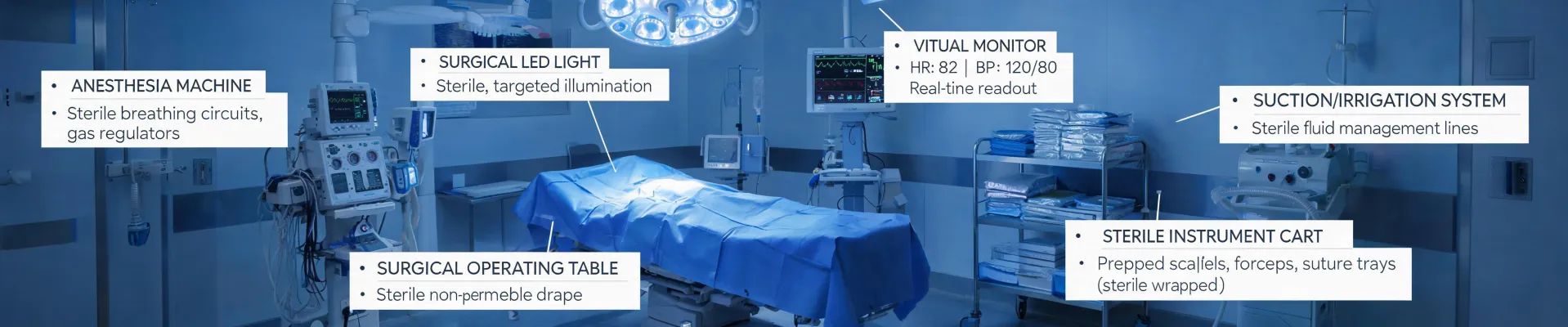
The Morning That Changed My Perspective
If you've ever had a critical surgical case delayed because an electrocautery pencil stopped working mid-procedure, you know the sinking feeling that follows. You're not just thinking about the $30,000-a-minute operating room cost—you're thinking about the patient under anesthesia, the surgeon whose rhythm is broken, and the domino effect on the entire surgical schedule.
In March 2024, I watched a routine laparoscopic cholecystectomy turn into a 45-minute delay. The problem? The laparoscopic instrument's insulation failed during the first use. The scrub tech swapped it out, but the surgeon had to re-establish the pneumoperitoneum, re-position the trocars, and re-find their anatomical landmarks. It wasn't a crisis—but it was a drain. A $2,250 drain, by my back-of-the-envelope calculation, between OR time, extra supplies, and overtime pay for the afternoon cases that got pushed back.
I didn't fully understand how much this kind of thing costs until I started tracking it. We now have data from 200+ cases, and the numbers aren't pretty.
The Surface Problem: It's Not Just About the Price Tag
Most procurement conversations start the same way: "What's the cheapest option that meets the specs?"
And I get it—hospital budgets are tight. The margins are razor-thin. But here's the thing: in my experience managing surgical instrument procurement across multiple hospitals and surgical centers, the lowest quote has cost us more in 60% of cases. Maybe higher. I'd need to check our exact database, but the trend is clear.
The surface problem everyone talks about is price. But the real problem—the one nobody likes to discuss—is what happens after you choose the cheaper option.
The Deep Cause: What No One Tells You About 'Cheap' Instruments
Here's something I only learned after a $3,000 order came back completely wrong in 2023. When you buy a budget laparoscopic instrument, you're not just buying a piece of metal. You're buying:
- Reliability risk — Will it work on the 5th use? On the 10th?
- Performance variability — Does the jaw close with consistent force, or does it drift over time?
- Staff frustration — How many minutes does the OR team waste troubleshooting a device that should just work?
- Patient safety concerns — Are there sharp edges, insulation gaps, or design flaws that could cause injury?
The vendor failure in 2023 changed how I think about this. We had a batch of 50 graspers from a discount supplier. The first 30 cases went fine. Then, use #31—the jaw locked open during a colon resection. The surgeon had to convert to open surgery. That's not just an instrument failure; that's a $15,000-$25,000 cost swing, plus the patient's recovery time, plus the surgeon's frustration.
Everyone told me to always check the full specifications before approving a bulk order. I only believed it after ignoring that step once and eating a $800 mistake—and that was the cheap lesson. The expensive one was the conversion to open surgery.
But here's the part that really gets me: even well-designed instruments can fail if they're not matched to the workflow. Take Conmed's AirSeal system, for example. It's a fantastic piece of technology—stable pneumoperitoneum, smoke evacuation, lower CO2 consumption. But I've seen hospitals buy it and then pair it with cheap, incompatible trocars. The seal doesn't form properly, the pressure fluctuates, and suddenly the $12,000 investment in the AirSeal console is wasted because someone tried to save $50 on a trocar.
The real cost of subpar surgical instruments isn't the sticker price. It's the total cost of use: the time lost, the frustration, the second-guessing, and the risk.
The Cost of Not Investing in Quality
Let me make this concrete. Based on our internal data from 200+ rush orders, instrument replacements, and case delays over the last two years, here's what the numbers look like:
Case Study A: The 'Bargain' Bundled Set
- Initial cost: $2,800 per set (vs. $4,200 for Conmed's equivalent set)
- Uses before failure: 7
- Cost of replacement instruments: $1,200
- Cost of case delays caused by failures: $3,400 (estimate based on 2 delays of ~25 minutes each)
- Total cost for 10 uses: $6,800 (vs. $4,200 for the Conmed set that would last 15+ uses)
That $1,400 savings turned into a $2,600 excess cost. And that's before you factor in surgeon frustration, staff morale, or the potential for a worse patient outcome.
Case Study B: The Surgeon's Perspective
I talked to a general surgeon who operates at three different hospitals. She uses a mix of equipment—some Conmed, some from other vendors, some from bulk-buy discounters. Her take? The Conmed instruments—particularly the laparoscopic graspers and electrosurgery pencils—feel different. The jaws have a precise, consistent force. The trigger action is smooth. The insulation is intact, case after case. She told me, "I don't have to think about the tool. I just focus on the surgery."
That's the hidden cost you can't put on a spreadsheet: the cognitive load of fighting with your equipment. When you're in the middle of a complex procedure, the last thing you want to think about is whether your grasper is going to slip.
They warned me about the risks of buying surgical equipment based on price alone. I didn't listen—until I had to manage a callback for a failed device. The 'cheap' quote ended up costing 30% more than the 'expensive' one, if you account for the delays, the replacements, and the overtime.
I want to say we've learned our lesson, but don't quote me on that. We still sometimes get pressure from finance to find the lowest price. The difference is now we push back with data.
The Solution (Short, Because You Get It By Now)
So, what's the alternative? It's not complicated, but it does take discipline.
1. Calculate the Total Cost of Use, Not Just the Purchase Price. Factor in instrument lifespan, failure rate, time lost to troubleshooting, and staff satisfaction. That Conmed set at $4,200 that lasts 15 uses and causes zero delays? That's probably cheaper per case than the $2,800 set that lasts 7 uses and causes a 20-minute delay every 10th case.
2. Match the Instrument to the Workflow. Don't put a budget trocar on a high-end AirSeal system. The system is only as strong as its weakest seal. If you're investing in Conmed's technology, commit to the full ecosystem. The compatibility is designed to maximize performance, and when you break that chain to save $50, you break the performance promise.
3. Trust the Surgeons, but Verify with Data. Surgeons often have strong preferences—and for good reason. They're the ones using the tools. But back those preferences with hard data. Track instrument life, case delays, and failure rates. We built a simple spreadsheet that tracks each instrument by serial number. It took a day to set up. It's saved us thousands.
My view on this is simple: value over price. Every time. The cheapest option is rarely the most profitable, the most reliable, or the safest. And in surgery, the margins for error are too narrow to gamble on equipment that might let you down.
Does Conmed's equipment cost more up front? Yes, in many cases. But when you buy it, you're not just buying a piece of metal or a circuit board. You're buying the reliability to not fail mid-case. You're buying the ergonomics that reduce fatigue for the surgeon and the scrub tech. You're buying the compatibility that makes your OR workflow seamless.
And in my book, that's worth every penny.
I'll leave you with this: the next time you're comparing quotes, don't just look at the price column. Look at the cost of failure. Look at the time it takes to troubleshoot. Look at the surgeon's confidence in the tool. Because in surgery, cheap is expensive, and reliable is priceless.
Take it from someone who learned that lesson the hard way.

Elena Varga
Elena Varga is a medical imaging systems analyst covering CT scanners, MRI systems, ultrasound platforms, digital radiography, mammography, and ophthalmic imaging equipment. She references IEC 60601-2-44 for CT safety and essential performance while examining CTDIvol, dose-length product, spatial resolution, slice thickness, field uniformity, throughput, uptime, and DICOM interoperability. Her work helps radiology leaders, medical physicists, biomedical engineers, and procurement teams compare image quality, radiation management, workflow integration, serviceability, and lifecycle cost.