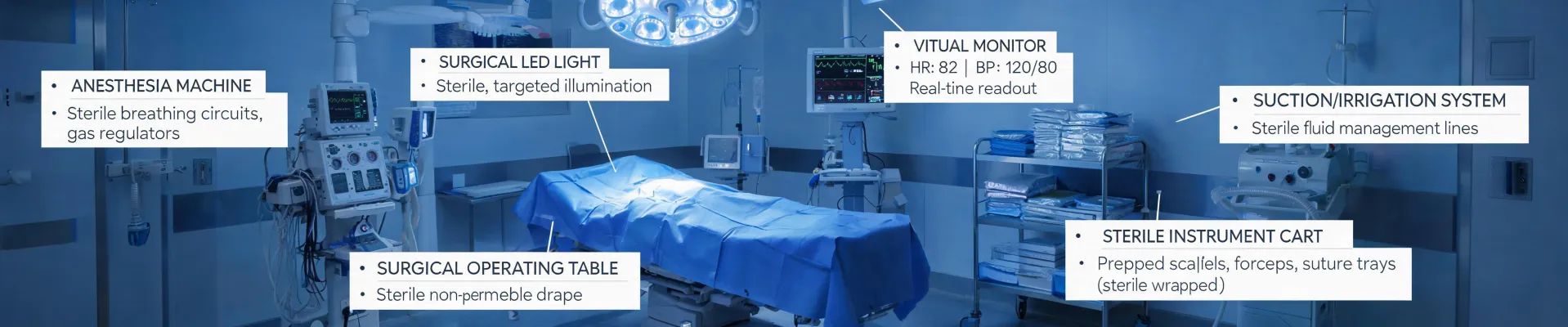
If the OR schedule depends on it, don't gamble on delivery
In five years of managing equipment procurement for a mid-size surgical center, I've learned one thing: certainty is worth the premium. When I needed a Conmed AirSeal system for an urgent laparoscopic case, I paid $300 extra for expedited shipping. The alternative was delaying a $12,000 surgery. That's an easy call. But I didn't always think this way.
I took over purchasing in 2020. We process about 60–80 orders a year across 8 vendors – maybe 70, I'd have to check the system. My job is to keep surgeons happy and the budget balanced. Early on, I focused on per-unit pricing. That was a mistake.
What most buyers miss
People ask 'what's your best price?' They should ask 'what's your guaranteed delivery window?' The difference is everything. I once saved $80 by choosing standard shipping for a pulse oximeter. It arrived two days late. The surgeon rescheduled the case, and the OR idle time cost us $1,400. Net loss: $1,320 (not counting the annoyed surgeon).
The irony? That pulse oximeter was from a brand we trusted – but trust doesn't guarantee logistics. I now verify shipping commitment before any order. For critical items like a Conmed cautery or an AirSeal insufflator, I budget for expedited delivery. (I should mention: Conmed's official website lists their shipping options clearly – that transparency helps.)
When 'probably on time' isn't good enough
Here's the pattern: unreliable cheap delivery costs more than reliable premium delivery. I learned this the hard way in a 2024 vendor consolidation project. We had 3 locations, 400 employees, and a tight timeline. I chose a low-cost logistics provider for a batch of mobility scooters (non-critical, for patient transport). They missed the deadline by a week. The scooters weren't urgent, but the delay still caused complaints. Now imagine if that had been a surgical instrument.
The opposite scenario: a surgeon needed a specific endoscopic device – a Conmed product, if I recall correctly. Standard lead time was 5 days, but the case was in 3. I paid the rush fee. It arrived on time, case went smoothly. Cost of rush: $150. Cost of delay: probably $4,000 in lost revenue. That math is simple.
But not everything needs a rush
I'm not saying you should always pay for speed. For non-critical items – say, a box of pipettes for the lab – standard delivery is fine. The key is distinguishing urgent need from routine resupply. A mobility scooter can wait a week. A Conmed AirSeal system for a booked surgery cannot. That's the decision framework I use: if the consequence of missing the deadline is more than the premium, pay it. Otherwise, don't.
One more thing: I always check the vendor's cancellation and revision policy. (Surprise, surprise – budget vendors often charge hidden fees for changes.) Per FTC guidelines, claims like 'fastest delivery' need substantiation. I ask for written guarantees. Conmed's official website, for instance, clearly states their expedited service terms – that's the kind of clarity I look for.
Honest limits of this approach
Does paying extra always work? No. I've had a rush order delayed anyway (ugh). But the vendor refunded the fee. Standard shipping wouldn't have any recourse. The point is: paying for certainty gives you leverage and transparency. It's not about speed – it's about knowing what you'll get and when. In healthcare procurement, that certainty is worth a premium.

Elena Varga
Elena Varga is a medical imaging systems analyst covering CT scanners, MRI systems, ultrasound platforms, digital radiography, mammography, and ophthalmic imaging equipment. She references IEC 60601-2-44 for CT safety and essential performance while examining CTDIvol, dose-length product, spatial resolution, slice thickness, field uniformity, throughput, uptime, and DICOM interoperability. Her work helps radiology leaders, medical physicists, biomedical engineers, and procurement teams compare image quality, radiation management, workflow integration, serviceability, and lifecycle cost.