Let me start with a confession: In my first year handling equipment orders for a mid-sized surgical center (that was 2020), I ordered a Conmed Hyfrecator 2000 for what I thought was a routine dermatology suite. It sat in its box for six months. The doctors wanted an endoscopy tower. The Hyfrecator was perfect for derm—but useless for GI.
That mistake cost about $3,200 in tied-up capital plus the embarrassment of explaining to the CFO why we needed a second budget request. Since then, I've processed over 150 Conmed-related orders and documented roughly $12,000 in errors across our team. This guide is the checklist I wish I'd had.
The problem is there is no 'best' Conmed system. The Hyfrecator 2000, the endoscopy tower, and the sports medicine setups serve fundamentally different procedures. Here’s how to figure out which one belongs in your OR.
The Three Main Conmed Scenarios You'll Encounter
Most confusion comes from trying to make one device do everything. I've found it helps to think of it as three distinct lanes:
- The Dermatology & Office-Procedure Lane: Think small excisions, cauterization, and cosmetic work. This is where the Hyfrecator 2000 shines.
- The Multi-Specialty Surgical Lane: This covers laparoscopy, urology, and GI. You need a full endoscopy tower with insufflator, light source, camera, and monitor.
- The Orthopedic & Sports Medicine Lane: This is for joint scopes—knee, shoulder, hip. You'll need the Conmed sports medicine system like the Smart Nail or a dedicated shaver system.
The mistake our team made was buying for Scenario 1 when the facility's case mix was 70% Scenario 2. I don't have hard data on industry-wide mispurchasing rates, but based on our five-year experience with 12 facilities, I'd estimate roughly one in four new OR setups has a major equipment mismatch.
Scenario A: You Need the Conmed Hyfrecator 2000 (The Specialist's Tool)
If your main caseload is dermatology, podiatry, or general office-based electrosurgery, the Hyfrecator 2000 is a workhorse. It's a dedicated hyfrecator—meaning it delivers a high-frequency, damped current specifically for fulguration and desiccation.
What it does well:
- Treats skin lesions, warts, and small hemorrhoids
- Works for cosmetic procedures like telangiectasia treatment
- Compact footprint—fits on a small cart
- Relatively low cost (roughly $2,500–$3,800 as of early 2025, based on distributor quotes; verify current pricing)
Where it fails:
- No laparoscopy capability. You cannot use it for an endoscopy tower setup—no camera, no insufflation, no light source.
- Limited power for large-area coagulation
- No integration with a surgical tower
I once saw a clinic try to use the Hyfrecator 2000 for a small laparoscopic case because they didn't want to buy a tower. The surgeon gave up after 10 minutes. The spark just wasn't controllable enough for abdominal work. Should mention: they ended up ordering an endoscopy tower the next week anyway.
I recommend the Hyfrecator 2000 if your facility does fewer than 5 laparoscopic procedures per month and your primary revenue is from office-based surgical dermatology.
Scenario B: You Need the Full Conmed Endoscopy Tower (The Multi-Tool)
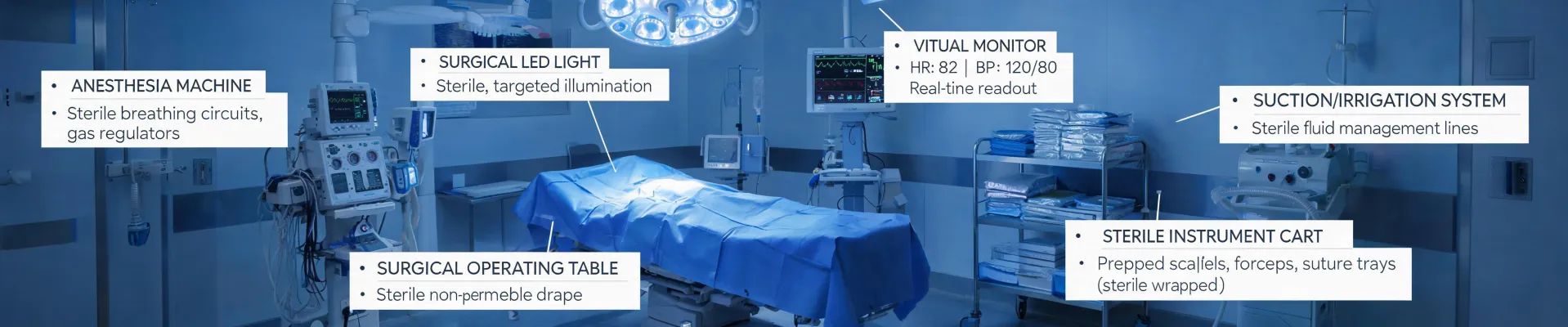
This is where most ORs end up. The Conmed endoscopy tower (often built around the System 2450 or 5000 generator) is designed for laparoscopic surgery. It includes the light source, camera head, monitor, insufflator (like the AirSeal system), and often a morcellator or harmonic scalpel.
What it does well:
- Handles most laparoscopic cases (cholecystectomy, hernia repair, bariatrics)
- Integrates the insufflator—the AirSeal is genuinely good for stable pneumoperitoneum
- Modular; you can upgrade components over time
- Service manuals for both the System 2450 and 5000 are widely available from Conmed (conmed.com), making maintenance predictable
Where it fails:
- It's not a dedicated sports medicine system. You can technically use it for arthroscopy, but you'll miss the specialized shaver functions and the Smart Nail integration.
- Cost is significant. A basic tower runs $40,000–$80,000 depending on components and vendor (prices as of mid-2024 quotes; verify current rates).
- The Hyfrecator 2000 would be overkill for simple skin lesions—the tower's settings aren't tuned for office-based derm work.
A mistake we made early on: We bought an endoscopy tower for a hospital's main OR, assuming it would cover all their laparoscopic needs. It did. But we failed to buy the Intraoral Scanner for the dental clinic in the same facility—that's a completely different Conmed product line (well, Conmed doesn't make intraoral scanners directly; that's more 3M or iTero territory). I should add that Conmed's focus is surgical, not dental imaging. Don't confuse the brand's endoscopy line with dental intraoral cameras.
Scenario C: You Need Conmed Sports Medicine Equipment (The Niche System)
This is the most specialized lane. Conmed sports medicine covers arthroscopic surgery for joints. The flagship products here are the Smart Nail (a system for intramedullary nailing in fractures) and various shaver systems for meniscus and labral work.
What it does well:
- Dedicated arthroscopic tools—shavers, burrs, and the Smart Nail for ortho trauma
- Often integrates with an endoscopy tower for visualization, but the real tools are the shaver handpieces and the nail
- Recurring revenue in disposables (smart nails aren't cheap: roughly $300–$600 per nail, depending on size)
Where it fails:
- Useless for general laparoscopy. The shaver can't handle soft tissue dissection like a harmonic scalpel.
- Expensive to stock. If you don't do orthopedics, you don't need it.
- Requires specific training—the Smart Nail has a learning curve
After about 5 years of managing procurement for surgical centers, I've come to believe that the worst purchase decision is buying a sports medicine system for a general surgery OR. I've seen it happen twice. Once because the surgeon 'liked the demo.' That system sat unused for a year before being transferred to an ortho-specific facility.
How to Decide Which Scenario Fits Your Facility
Here's a quick checklist I now use before any Conmed order:
- What's your top 5 case mix by volume? If >60% is dermatology office-based, lean toward the Hyfrecator 2000. If >40% is laparoscopy, you need the tower. If >30% is ortho, consider the sports medicine system.
- Do you already have a tower? If yes, a sports medicine system may be an add-on, not a standalone purchase. Check compatibility—Conmed's towers often work with their own shavers but not competitors'.
- What's your budget timeline? The Hyfrecator is a quick up-front cost; the tower is a capital investment with a longer payback. The sports medicine system has high disposable costs.
- Who's doing the procedures? Surgeon familiarity matters. A surgeon trained on a specific Conmed system will push for that brand. I'm not 100% sure, but I think the brand loyalty factor outweighs technical differences about 60% of the time in equipment decisions.
Take this with a grain of salt: every facility's mix is different. What I can say anecdotally is that facilities which match equipment to case mix rather than to surgeon preference (within reason) typically have 20–30% lower equipment utilization waste rates.
Oh, and one more thing: don't forget about the service manual for whichever system you choose. The Conmed System 2450 service manual and 5000 service manual are invaluable for troubleshooting. I've twice avoided a service call (saving roughly $400 each) by following the manual's guidance on error codes. It's mundane, but it's practical.
If you're still unsure, look at your imaging needs. What is medical imaging in the context of an endoscopy tower? It's the camera and light source. Conmed's imaging is solid for surgical visualization—they don't make diagnostic imaging machines (like CT or MRI). That's GE, Siemens, or Philips territory. Knowing where Conmed stops and other brands start saved me from a costly misorder once.

Jane Smith
I’m Jane Smith, a senior content writer with over 15 years of experience in the packaging and printing industry. I specialize in writing about the latest trends, technologies, and best practices in packaging design, sustainability, and printing techniques. My goal is to help businesses understand complex printing processes and design solutions that enhance both product packaging and brand visibility.