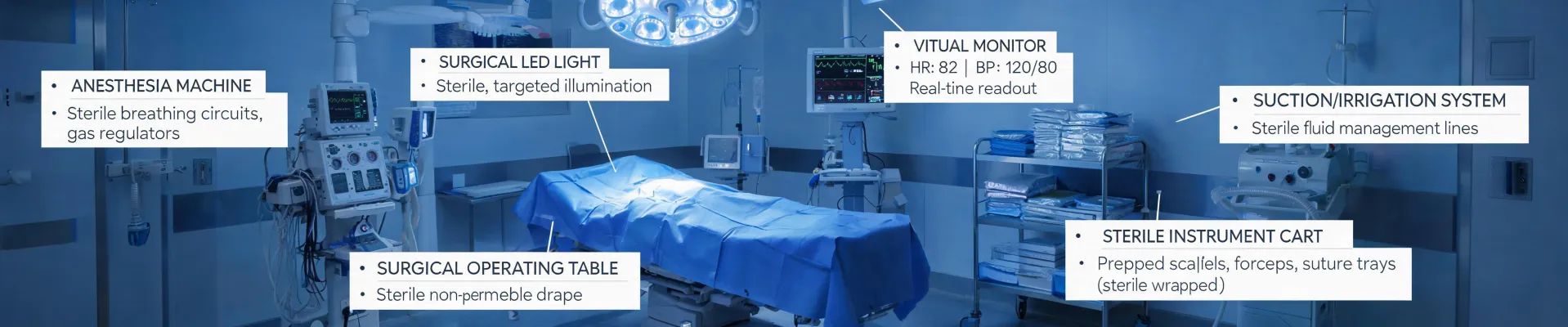
Look, I'm going to say something that might annoy a few people. The cheapest quote for surgical equipment is almost always the most expensive option you can pick. I'm an office administrator for a mid-sized surgical center—I manage all our medical supply ordering, roughly $2.5 million annually across a dozen vendors. When I took over purchasing in 2020, I made this exact mistake with our surgical lights. And I paid for it.
The Sticker Price Trap
Our first big equipment buy after I got the job was a set of new surgical lights for our main operating suite. I got three quotes. The cheapest was from a smaller distributor, about 40% less than the brand-name options. I'm not a surgeon or a biomedical engineer, so I can't speak to the optical quality or the ergonomics from a clinical perspective. What I can tell you from a procurement perspective is that the "cheap" lights cost us nearly double what I saved in the first year alone (ugh).
The surprise wasn't just the failure rate. It was the hidden costs. Within six months, two of the four lights had color-temperature drift—the light looked yellow compared to our other units. The surgeon complained. We had to send them back for recalibration, which cost $400 per unit in shipping and handling (not covered under their basic warranty). Then the replacement bulbs—the original vendor used a non-standard mount, so we couldn't use the stock we had for our other lights. We had to buy from them, at a 60% markup.
What Total Cost of Ownership Actually Looks Like
I now calculate Total Cost of Ownership (TCO) before comparing any vendor quotes. Here's what goes into my spreadsheet:
- Base unit price — the sticker price (obviously)
- Installation and calibration — does the quote include setup, or is that extra?
- Training costs — how many hours does my staff need to learn the new system?
- Consumables and replacement parts — are they standard, or proprietary?
- Warranty depth — what's covered, what costs extra, what's the response time?
- Downtime risk — how often does this model need service, and how fast is support?
People think that expensive vendors deliver better quality because they charge more. Actually, vendors who deliver quality can charge more because they've invested in it. The causation runs the other way. Conmed's surgical lights (which we eventually switched to) weren't the cheapest quote we got. But their documentation was clear, the warranty was comprehensive, and their service manual was actually accessible—not hidden behind a login or requiring a certified technician to interpret. I'm not a logistics expert, so I can't speak to carrier optimization. But I can tell you that a vendor who provides a proper invoice (every time) and whose replacement parts are available without a product code scavenger hunt saves my accounting team about two hours per order. That's real money.
My Experience with Conmed Advanced Surgical Catalog
Here's a specific example. After the light fiasco, I was tasked with sourcing a new electrosurgical unit. I went directly to the Conmed official website and pulled their advanced surgical catalog. The Conmed System 2450 was listed with a service manual available online, and the parts catalog was searchable by part number. I didn't need to call a sales rep and wait two days for a quote (which, honestly, is a massive hidden cost in itself). Processing 60-80 orders annually, I've learned that time is a cost. The vendor who can't provide a simple online ordering portal costs you in staff hours.
"The $1,200 cheaper quote became $1,800 more after revisions, proprietary parts, and downtime."
Never expected that a vendor with better documentation would be a better investment. Turns out their process was actually more refined for our specific needs. Conmed's laproscopic instruments and endoscopy lines were similarly well-organized. I could find the AirSeal system specs, the Smart Nail details, and the service requirements without a deep dive into support tickets.
Why People Disagree with Me (And Why I'm Still Right)
My experience is based on about 200 mid-range equipment orders over five years. If you're working with ultra-budget vendors in completely commoditized categories (like basic surgical drapes or non-critical disposables), your experience might differ significantly. But for capital equipment—surgical lights, electrosurgical generators, patient monitoring systems, vagus nerve stimulators, gait analysis systems—the TCO framework is essential.
The question isn't "which vendor is cheaper?" It's "which vendor costs less, total?" Lowest unit price almost never equals lowest total cost. Here's the thing: most of those hidden fees are avoidable if you ask the right questions upfront. Ask for the full TCO breakdown. Ask about proprietary parts. Ask about warranty response times. Ask for the service manual before you buy.
One Last Thing
I'm not saying never buy from a less expensive vendor. I'm saying don't make that decision based on unit price alone. The 'cheapest' option isn't just about the sticker price—it's about the total cost including your time spent managing issues, the risk of delays, and the potential need for redos. When I consolidated orders for 400 surgical cases across 3 locations last year, I used a TCO spreadsheet for every vendor. It flagged a seemingly cheap alternative to our Conmed setup that would have cost us an extra $12,000 in training and downtime alone. That unreliable supplier would have made me look bad to my VP when the equipment arrived late and didn't integrate with our existing system.
My advice? Download the Conmed advanced surgical catalog. Get the full quotes. Calculate your own TCO. The sticker price is not the price.

Jane Smith
I’m Jane Smith, a senior content writer with over 15 years of experience in the packaging and printing industry. I specialize in writing about the latest trends, technologies, and best practices in packaging design, sustainability, and printing techniques. My goal is to help businesses understand complex printing processes and design solutions that enhance both product packaging and brand visibility.