-
Before The Questions
-
1. Is there a Conmed official website, and should I start there?
-
2. What should I check before buying a refurbished Conmed electro surgical unit?
-
3. What belongs in an endoscopy tower?
-
4. Does Conmed make a blood analyzer?
-
5. What is molecular diagnostics?
-
6. What procurement question do people forget until the equipment is on the loading dock?
Before The Questions
I buy supplies and capital equipment for an outpatient surgery center. I am not a surgeon or a biomed engineer; I am the person who asks the boring questions before somebody signs a purchase order. We do about 1,700 procedures a year across GI, urology, and sports medicine, and I have ordered Conmed devices long enough to learn what to check and what to skip. Use this as a starting point, not as your final equipment specification.
1. Is there a Conmed official website, and should I start there?
There is a Conmed official website at conmed.com. That is the place I start for current product information, instructions for use, and customer service contacts. I use it to confirm model numbers before I speak to a distributor or a refurbisher.
It is worth knowing that the official product catalog will not list every refurbished unit. Refurbished equipment usually comes from an independent medical device reseller, so you have to check the exact model on conmed.com and then ask the seller how their testing process works. I also ask Conmed customer service whether the model still has an active parts and service path. A cheap unit with no future support is not a bargain.
2. What should I check before buying a refurbished Conmed electro surgical unit?
In early 2024 our backup electrosurgical generator failed. We had cases booked and the purchase budget was already tight, so a refurbished Conmed electro surgical unit sounded like the sensible call. I had maybe four days to decide; normally I would take two weeks to compare quotes and references. In hindsight, I wish I had pushed for a rental bridge first.
First, ask for the exact model, serial number, and current 510(k) clearance if you are in the US. Second, ask for a test report showing the unit meets the original manufacturer output specification. Third, confirm what accessories are included: cables, foot switch, patient return electrode. Fourth, ask for the IFU and service documentation. If a seller cannot or will not explain their verification process, that is a red flag.
I recommend refurbished units more for backup or low-volume rooms than for the only generator in a busy OR. If it has to run every day, new or a full service contract is safer. Even after we picked our unit, I kept second-guessing until the biomed tech passed it. That feeling passes once the test report is real.
3. What belongs in an endoscopy tower?
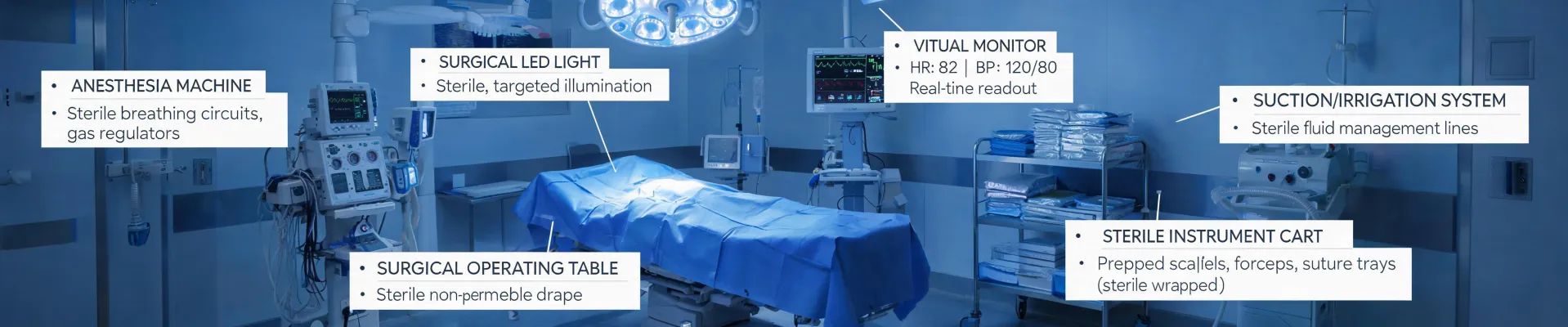
An endoscopy tower is the mobile cart and stack used during minimally invasive procedures. It usually includes a high-definition monitor, camera control unit and camera head, light source, image processor, insufflator, and sometimes a video recorder or irrigation pump. Electrosurgical units are often nearby too, especially when the procedure needs cautery.
When a surgeon asks me for a Conmed endoscopy tower, they usually mean a complete setup, not a single SKU. Conmed makes parts of that stack, including insufflation and visualization products. A dealer can assemble the whole system, but it is never one box. If you buy used, the pieces may come from different sources.
That creates the compatibility question. I once assumed that two components sharing the same video connector would communicate automatically. They did not. The tower needed an interface I did not plan for. Now I ask one vendor to quote the monitor, camera, light source, and cart together and verify the combinations before delivery.
4. Does Conmed make a blood analyzer?
Short answer: no, not the laboratory kind. Conmed focuses on surgical instruments, endoscopy, electrosurgery, patient monitoring, and sports medicine. A patient monitor showing pulse and oxygen saturation is not a blood analyzer in the lab sense.
I keep seeing this search phrase. Usually it comes from someone who is building a supplier list and groups all hospital equipment together. If your facility asks for a blood analyzer, clarify first: do they mean blood gas, glucose, complete blood count, electrolytes, or molecular tests? Those are different instruments with different regulatory and handling requirements. One vague request cannot lead to one smart purchase.
5. What is molecular diagnostics?
Molecular diagnostics is a laboratory discipline that detects DNA, RNA, or other genetic material in a sample. Instead of measuring a chemical or looking at cells under a microscope, it looks for the genetic fingerprint of a disease, virus, or inherited change. Polymerase chain reaction, nucleic acid amplification tests, and sequencing all fit under this umbrella.
This is a confusing category for an administrative buyer because molecular diagnostics is not a single brand category. It is a set of platforms and chemistries. If a hospital wants to build a molecular diagnostics capability, the procurement path involves pathologists, lab managers, and health system IT. Do not let the OR equipment rep design that lab.
Why does it show up near a Conmed keyword search? Search intent can be messy. A person researching medical capital equipment might type several terms in one session. The important part is to separate clinical categories before comparing brands.
6. What procurement question do people forget until the equipment is on the loading dock?
The question is: what has to happen between delivery and clinical use? For a refurbished Conmed electro surgical unit, that includes cables, test reports, a qualified person who checks it, and staff training. For an endoscopy tower, it includes mounting, video interfaces, power, and wipe down in the right sequence.
One project I still think about almost went sideways because the price covered the equipment but not the mounting bracket and installation time. The bracket was a small line item, but it became a delay because nobody asked earlier. Now every RFQ I send includes this line: list all accessories, installation tasks, compatibility checks, and documents needed before the first case. If a supplier sees it and hesitates, that tells me something useful.
I will not tell you that one device is best for every OR. No such thing. The right option depends on your case mix, staff, facility, and service coverage. But I can tell you that a device sitting unopened because it does not fit or has no setup plan is worse than waiting one more week for a better quote.

Elena Varga
Elena Varga is a medical imaging systems analyst covering CT scanners, MRI systems, ultrasound platforms, digital radiography, mammography, and ophthalmic imaging equipment. She references IEC 60601-2-44 for CT safety and essential performance while examining CTDIvol, dose-length product, spatial resolution, slice thickness, field uniformity, throughput, uptime, and DICOM interoperability. Her work helps radiology leaders, medical physicists, biomedical engineers, and procurement teams compare image quality, radiation management, workflow integration, serviceability, and lifecycle cost.