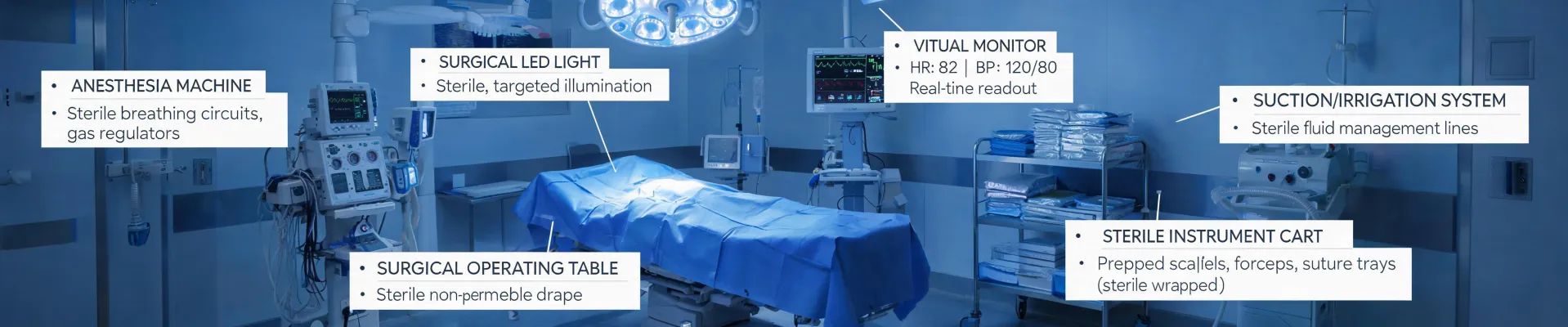
At 2:37 on a Tuesday in April 2023, the electrosurgical generator in OR 2 refused to fire. No pop, no smoke, no dramatic shutdown—just a low fault tone, a red indicator, and silence. The surgeon looked over her shoulder and asked what the backup plan was. I didn't have one.
The generator was the refurbished Conmed electro surgical unit I had pushed the center to buy two months earlier. On paper, it saved us $4,850. When the dust settled, I calculated that we were lucky to break even. The most expensive part, though, wasn't a dollar amount. It was the lesson about what “refurbished” actually means.
Quick context on who's telling you this: I'm not a biomedical engineer. I can't walk you through circuit-level diagnostics. I'm a supply and equipment coordinator, and I've been handling equipment and supply purchases for ambulatory surgery centers for seven years. In that time I've made and documented mistakes. This one sits near the top.
My original question was simple: how do I find a reputable seller of refurbished equipment? That was the wrong question. The right question was: what will this device require from the people who use it? I learned that the hard way.
Why a Refurbished Unit Looked Like the Only Sensible Move
Our center is small. Two ORs, one minor-procedure room, about forty procedures a week. Capital budget is tight. We needed a second electrosurgical generator so the rooms weren't sharing one machine, and the quote for a new Conmed generator came back at $6,800.
A distributor then offered a refurbished Conmed electro surgical unit for $1,950. The listing placed it in the Conmed Advanced Surgical portfolio and said the unit was tested, carried a one-year warranty, and came with a validation packet.
I ran the numbers repeatedly. $4,850 in savings, assuming the refurbished unit worked as advertised. The upside was real. The risk? In my head, the worst case was that the unit failed and we swapped it out for the old generator, which had never once failed in twelve years. The expected value said buy.
It Worked for Six Weeks. Then It Stopped a Case.
The unit arrived clean, powered up, and passed its self-test. I checked output with the Conmed pad and pencil that came in the box. Everything looked consistent. I signed the acceptance form, and the unit went into OR 2.
For six weeks, it was fine. Then we opened a new box of return electrodes—the generic “universal” pads I'd approved to save money once the old stock ran low.
On that Tuesday, the circulating nurse applied one of the new pads. At 2:37 p.m., when the surgeon activated the handpiece, the generator faulted and refused to output. The nurse replaced the pad with another from the same box. Same fault. We tried a third time, then called off the case and rescheduled the patient. The surgeon wasn't angry. That was almost worse.
I Wanted to Blame the Refurbisher. The Refurbisher Wasn't the Problem.
I spent a day convinced the seller had sent a bad unit. An independent biomedical technician came in, ran output and electrical safety checks, and confirmed something I didn't want to hear: the generator was functioning properly. The problem was in my assumptions, and I had made three of them.
First, I treated the generator as if it were a standalone box. It isn't. An electrosurgical system is made up of the generator, a handpiece, a footswitch, a return electrode, and a patient-contact monitoring loop. The generator checks the return electrode's electrical signature before and during use. If a “universal” pad doesn't match the signature it was designed to see, the generator assumes the pad isn't safely adhered and cuts output. That is a burn-prevention feature, not a flaw.
The pad I used during acceptance was the original Conmed pad that came with the unit. It was never the pad we would use in daily surgery. I validated the box under perfect conditions and then put it into service under real ones. That mismatch is the second mistake, and it's entirely mine.
The third mistake is structural. In a hospital, a clinical or biomedical engineer reviews equipment before purchase and checks compatibility of accessories. A small ambulatory center often doesn't have that position. The person signing the purchase order is also the person evaluating the maintenance plan, the service history, and the return-electrode inventory. That was me, and I had no idea what I didn't know.
That same blindness showed up in smaller purchases. A few months before the ESU incident, I was reviewing technical documentation for wound care products and hit an acronym I couldn't explain: ELISA. I typed “what is elisa” into a search bar at home that night. ELISA stands for enzyme-linked immunosorbent assay: a lab technique that uses antibodies and an enzyme-triggered color change to detect and measure a specific protein or other molecule in a sample. In that document, the test was the evidence behind a claim about an active ingredient. Reading the explanation didn't make me a specialist; it made me realize how often I was making decisions without one in the building.
I don't have hard data on how many refurbished units fail. What I can tell you is that in this case, the device did its job exactly as designed. The failure was in my buying process.
The True Cost of the Discount
Let's put numbers on it. The wasted box of universal pads: $412. The independent biomed's time: $380. Overnight shipment of compatible Conmed return electrodes: $615. Staff overtime and rescheduling work: about $900. The postponed case cost the center roughly $2,200 in facility revenue that day. Add it up and the total is north of $4,700—which means the $4,850 we “saved” was almost gone before counting the surgeon's patience and the patient's wasted afternoon.
If you're in a similar position, I hope you don't read this as a warning against refurbished equipment. I still think it can be a smart purchase. I read it as a warning against buying a component when you haven't thought through the system it belongs to.
The Checklist I Use Now
Since Q1 2024, I've used a pre-purchase checklist for every piece of clinical equipment. It isn't long, but it has caught 47 potential errors in 18 months. The core questions:
- What accessories are required for this device to function in our actual surgery workflow, and is each item included in the quote?
- Can I test the device with the exact pads, pencils, cables, footswitches, and staff who will use it—before I pay the balance?
- Who will verify that this unit still meets the applicable medical electrical safety standard, and can I see the report?
- If something fails, what does the warranty actually cover—and does the seller accept returns without restocking fees?
- If no clinical engineer is on staff, what will an independent biomedical review cost before purchase? Ours was $380. Cheap.
I use a scaled-down version for clinical supplies too. If a vendor of wound care products gives me a certificate with a test I can't interpret, I ask them to explain it in writing—and I read the explanation. That's how the “what is elisa” question stopped being embarrassing and started being routine.
The same discipline applies at any price point. Two months later, I applied the same list to a C-arm system quote and asked who would install it, who would test it, and which accessories were excluded. Those questions changed the total by thousands of dollars. A C-arm system, a patient monitor, or a refurbished Conmed unit—they all get evaluated as systems, not boxes. The depth of the review changes with the risk, but the logic doesn't.
One last thought for people working in small centers. Small doesn't mean unsophisticated, and it doesn't mean we deserve less support. The vendors who took our one-generator questions seriously—who answered in writing and didn't treat us as second-class because our order was small—are the ones I call first when the budget grows. A bad purchase isn't a small-center problem; it's a no-process problem. The fix isn't a bigger hospital. It's a checklist, followed honestly, before the PO goes out.
The refurbished Conmed unit is still in service today, with the right electrodes and a much better process around it. The equipment was never the enemy. My assumptions were.

Elena Varga
Elena Varga is a medical imaging systems analyst covering CT scanners, MRI systems, ultrasound platforms, digital radiography, mammography, and ophthalmic imaging equipment. She references IEC 60601-2-44 for CT safety and essential performance while examining CTDIvol, dose-length product, spatial resolution, slice thickness, field uniformity, throughput, uptime, and DICOM interoperability. Her work helps radiology leaders, medical physicists, biomedical engineers, and procurement teams compare image quality, radiation management, workflow integration, serviceability, and lifecycle cost.