First, work out which scenario you are in
Eight years ago I inherited a purchasing spreadsheet with two columns: item name, total. That was our entire cost model. Today I run procurement for a regional hospital system and two outpatient surgery centers, so the spreadsheet is uglier—roughly $1.7 million per year in surgical capital and supplies, tracked line by line since 2017.
When people ask about Conmed surgical instruments, the real question is usually not whether the company makes good products. It does. The real question is which configuration makes sense for your facility type, your caseload, and the support you can actually get. I don't have one universal answer, and I have learned to be suspicious of people who do.
Over seven years of purchase orders, I keep seeing three scenarios:
- A hospital with multiple operating rooms that is trying to standardize an existing fleet.
- An ambulatory surgery center that wants to take on more complex cases—including stent placement—instead of sending patients down the road.
- An office-based clinic building its first minor procedure room.
Each scenario has a different shopping list and, more importantly, a different total cost.
Scenario 1: The hospital standardizing a multi-room OR fleet
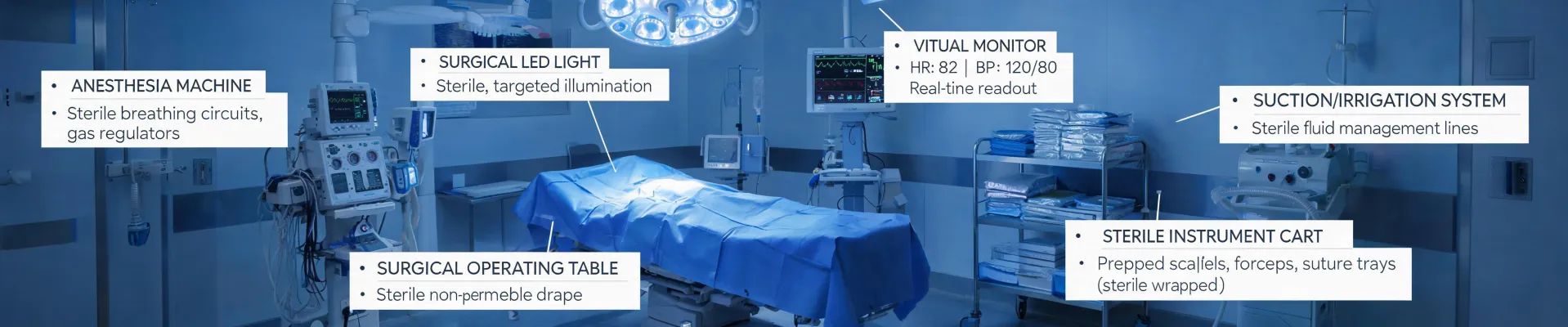
If you have more than four operating rooms running anything from general surgery to urology, your challenge is not buying equipment. It is keeping nurses, techs and surgeons competent on the equipment they use every shift. Standardizing on one energy platform and one set of support tools saves money because training, service contracts and backup inventory overlap.
Here is a boring cost item that actually matters: documentation. During our 2024 audit, we found exactly one current Conmed System 5000 user manual in a twelve-room suite. The rest were old revisions, partial photocopies, or a PDF that someone stored on a laptop that never left their office. We fixed that with a printed binder in every room and a current PDF on the shared drive. That sounds trivial until a newer nurse has to confirm the correct mode before a surgeon starts. A paper manual costs a fraction of one service call.
Training deserves the same discipline. Budget for one in-service per room and a simple competency check. Also ask your biomedical team where the service manual and the IEC 60601-2-2 acceptance test records live before the first case is scheduled. In the US, an electrosurgical unit is a Class II medical device, so this documentation is not optional paperwork. Put it in your total cost calculation from day one.
When I compare proposals, I compare five-year cost, not invoice price. Include freight, installation, staff training hours, annual service contract, expected repairs, disposables per month, and the cost of one cancelled case if a generator fails. A quote that looks cheaper at signing can become more expensive by year three if the service contract excludes common failures or if your staff needs to learn two different device families at the same time.
Scenario 2: The ASC that wants to keep stent cases local
Around here, the request comes up every year: why are we sending stent patients to the hospital when we have a clean scope suite and good staff? At first the conversation is clinical, and the googled phrase is usually how is a stent placed. But the second conversation is a purchasing one, and that is where I get involved.
How is a stent placed? (Short answer for equipment buyers)
An endoscopic stent is guided through the working channel of a scope, over a guidewire, and expanded or released once it is in position. Some stents are plastic and temporary; others are metal and designed to hold a duct open. In urology or biliary cases, fluoroscopy is often used to confirm placement. That is the clinical summary, and it is enough to change your capital plan.
Why? Because a stent procedure uses more than the stent. It uses the scope stack, light source, monitor, often a C-arm, guidewires, balloon catheters, the stent itself, and sometimes an electrosurgical generator when the physician needs to cut or cauterize tissue during the approach. If your equipment plan only includes the generator, you are missing half of the actual process cost.
In our ASC, we standardized on the Conmed System 5000 in the rooms doing these cases because the same model was already in the hospital ORs. That made it easier for traveling nurses and surgical techs to move between sites without retraining. That rationale is cost reduction, not brand loyalty.
The hidden inventory cost is expiration. Some stent sizes will sit on a shelf longer than expected, and stents do not last forever. We got burned on that once. Now we try to use consignment stock so the vendor only bills us when a stent is actually used. If your supplier will not offer consignment, make someone responsible for tracking lot numbers and expiration dates before the surgeon asks for a size that no longer exists.
Scenario 3: The office clinic buying its first minor procedure room
A clinic has a different set of rules. There is usually no biomedical engineering department, no central sterile processing team, and often the same person who hands you an instrument is the one who scheduled the appointment. The budget is also tighter, so every purchase has to justify itself.
Start with the basics: a reliable electrosurgical generator, a smoke evacuator, a small set of hand instruments—forceps, scissors, needle holder—and a patient monitor with the parameters your sedation protocol requires. A decent surgical instrument set can last a long time if it is reprocessed properly. That sounds obvious, but in a clinic, the reprocessing routine is often someone's side job.
One of the biggest mistakes in this setting is overbuying. If your clinic wants to offer spirometry as part of pre-operative screening or pulmonary assessment, a basic FDA-cleared spirometer that measures FEV1 and FVC might be enough. You do not need a full pulmonary function laboratory. The spirometer also does not need to match the brand of your surgical instruments or your patient monitor. Spend the money you save on something more useful: a service agreement with a guaranteed loaner unit or a backup device for the one procedure room you operate.
Which scenario are you actually in?
If you are still unsure, answer these four questions. How many rooms will use the equipment? Who fixes it when it breaks? What procedures are actually on your schedule for the next 18 months? And can you afford for that room to go dark for three days? Your answers will push you toward one of the three scenarios above.
Then run the same cost method on every vendor quote:
Total cost = purchase price + installation + staff training + service contract + unscheduled repairs + disposables and reprocessing + cost of downtime + removal or decommissioning − residual value.
The cheapest quote is a down payment, not a final cost. I buy Conmed surgical instruments fairly often because the platform keeps our training and service costs predictable across hospital and ASC sites. But at the end of the day, what controls your cost is not the name on the generator. It is having a current user manual where staff can find it, a service plan that actually responds, and a backup strategy that keeps your rooms running. Start there, and the brand decision gets much easier.

Elena Varga
Elena Varga is a medical imaging systems analyst covering CT scanners, MRI systems, ultrasound platforms, digital radiography, mammography, and ophthalmic imaging equipment. She references IEC 60601-2-44 for CT safety and essential performance while examining CTDIvol, dose-length product, spatial resolution, slice thickness, field uniformity, throughput, uptime, and DICOM interoperability. Her work helps radiology leaders, medical physicists, biomedical engineers, and procurement teams compare image quality, radiation management, workflow integration, serviceability, and lifecycle cost.