-
The March 2024 Call That Rewrote My Checklist
-
Refurbished Doesn't Mean 'Used,' But It Does Mean 'Documented'
-
The Five Things I Won't Skip Before a Unit Ships
-
What Is a Medical Trolley, and Why Did It Almost Cost Us a Case?
-
When 'Conmed Advanced Surgical' Shows Up on the Order
-
A Bipap Machine Is Never As Simple As It Looks
-
Neuromonitoring System Requests Need a Different First Question
-
When I'd Steer You Toward New Equipment Instead
-
The Final Word for Anyone Facing an Equipment Emergency
Here's the bottom line from seven years of coordinating urgent medical equipment orders: a rush order fails at the verification step, not the shipping step. In 2024 alone, I coordinated 47 rush orders for hospitals and surgical centers. Forty-five of those arrived on time and worked the moment they were unpacked. The two that didn't? Both failed after delivery, not before the truck left.
That sounds like a small distinction. It isn't. A unit that lands at 6:30 a.m. with the wrong footswitch is not a near miss. It's a delayed first case, a frustrated surgeon, and a conversation about why no one caught it earlier. When you're in an emergency, the one thing you don't have is time to fix mistakes.
Speed is a courtesy. Verification is the product.
That phrase has become something of a motto for me. I've run a 12-point checklist on every order since March 2024. It takes about twelve minutes, and it has prevented more cancelled procedures than every overnight courier I've ever paid for.
The March 2024 Call That Rewrote My Checklist
I didn't fully understand the value of that checklist until a Tuesday morning in March 2024. A hospital about 300 miles away called at 10:45. Their electrosurgical generator had failed during the first case of the day, and their backup unit was out for service. The lead time for a new generator from the original manufacturer? Six to ten weeks, easily. They needed a working unit by 6 a.m. the next morning.
We had a refurbished Conmed electro surgical unit in inventory that had just passed an inspection. So we did what a lot of suppliers do in a rush: confirmed it powered on, checked the basic cables, packed it carefully, and paid around $800 in overnight freight. It arrived on time. It powered on. Then the circulating nurse tried to connect the two-pedal footswitch her surgeons use for cut and coagulation, and it didn't fit. The unit shipped with a single-pedal footswitch.
Nobody had asked the obvious question: Which footswitch does your team actually use? The result was two procedures pushed back several hours and a hospital administrator who had every right to be unimpressed. The unit itself was fine. Our process wasn't.
That's when we changed the policy: nothing leaves our dock without a completed checklist that matches the equipment to the hospital's actual workflow—not just the model number on the purchase order.
Refurbished Doesn't Mean 'Used,' But It Does Mean 'Documented'
From the outside, refurbished sounds like a gamble. People assume a refurbisher wipes down the unit, replaces a fuse, and calls it good. The reality is that responsible refurbishment is a process: inspection, component replacement, testing, and cleaning. In surgical equipment, that process is what makes the device a clinical tool and not a paperweight.
A lot of buyers focus on the obvious things: Is it clean? Does it power on? What's the warranty? The question they should be asking is: What did the refurbisher test, and can I see the report? A generator can power on and still deliver output outside its calibrated range. That's not something you want to discover mid-case.
If you're considering a refurbished Conmed electro surgical unit, ask for the test documentation before you ask for a delivery date. No report is a red flag, no matter how good the price looks.
The Five Things I Won't Skip Before a Unit Ships
You don't need my full 12-point checklist, but these are the five checks I consider non-negotiable:
- Output verification: a qualified biomedical technician tests the generator with a calibrated electrosurgical analyzer in every mode the hospital intends to use.
- Exact accessories: the footswitch model, handpiece, patient return electrode, and cables must match what the OR already uses. Similar is not close enough.
- Consumable compatibility with the hospital's existing Conmed inventory, so the new unit doesn't create a second supply chain overnight.
- The mounting setup and the cart—which brings me to the most underrated piece of the whole order.
- A service report with test values, cleaning documentation, and a written warranty.
These five checks take roughly twelve minutes. In those same twelve minutes, a courier can move a package maybe 200 miles. The check is what keeps the delivery from becoming a failure.
What Is a Medical Trolley, and Why Did It Almost Cost Us a Case?
Let's talk about the item no one puts on the marketing brochure: the medical trolley.
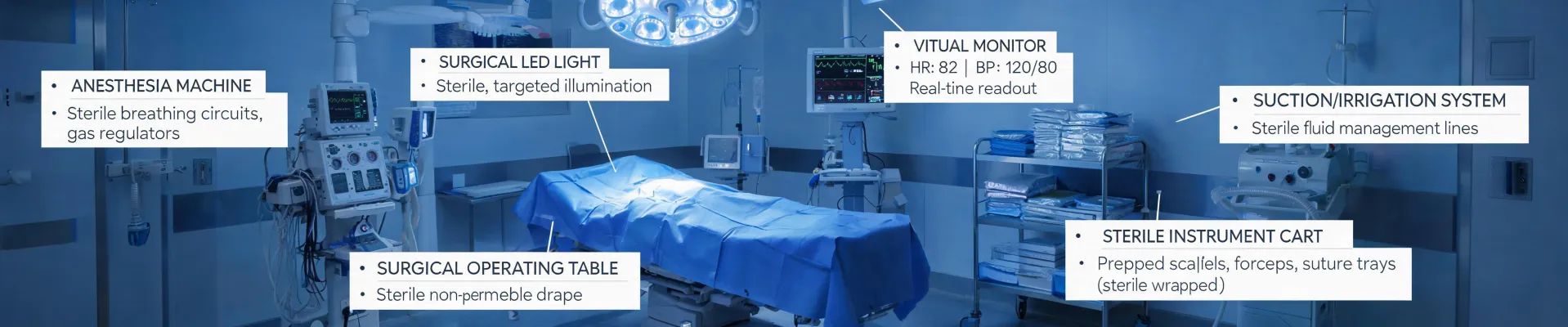
So, what is a medical trolley? In plain language, it's a wheeled cart designed to hold and transport medical equipment and supplies. In an operating room, the electrosurgical generator usually sits on a trolley, often beside a suction canister or a small monitor. But not every trolley fits every device. The shelf has to handle the weight, the mounting bracket has to line up, and the wheels have to lock securely enough that the unit doesn't shift when the team moves it mid-case.
I once watched a nearly perfect unit almost get rejected because no one had noticed the trolley's top shelf was a few centimeters short. It sounds small. It isn't. In an emergency, the team doesn't have time to improvise a mounting solution at 6 a.m. The trolley is a deal-breaker, even though it's the most boring item on the invoice.
When 'Conmed Advanced Surgical' Shows Up on the Order
When a hospital asks for Conmed advanced surgical equipment, it's usually not asking for one single device. The term covers several products used in minimally invasive surgery, including insufflation systems and surgical energy instruments. The AirSeal system is probably the best-known example, but it's part of a broader platform.
Here's what matters in an emergency: these systems are designed to work as integrated setups. An insufflation filter from another manufacturer might physically screw on, but it can change how the system senses pressure or clears smoke. If the hospital's existing tower uses a Conmed insufflation system, the replacement needs to match that exact system—not just 'fit' the connection. When someone tells you it's compatible with Conmed Advanced Surgical equipment, ask to see that claim in writing from the manufacturer before you order.
A Bipap Machine Is Never As Simple As It Looks
Respiratory equipment requests come from a different department, but they follow the same pattern. A bipap machine—the generic term is bilevel positive airway pressure; BiPAP is technically a trademark—delivers two levels of air pressure to support a patient who is struggling to breathe. It can keep certain patients off a ventilator entirely, which makes it a high-priority item when it fails.
In September 2024, a facility needed a bipap machine in under 48 hours. The hardware was available, but the question that saved the order wasn't about pressure settings. It was about which patient masks and circuits the facility already used. We matched the machine to their existing interfaces instead of shipping a generic setup, so the respiratory therapist didn't have to retrain staff during an emergency.
Most equipment emergencies aren't about the biggest device. They're about the small detail that everyone assumes someone else checked. The bipap machine taught me that again: the question everyone asks is whether the unit has the right pressure range. The question they should ask is whether it works with their current masks, circuits, and oxygen setup.
Neuromonitoring System Requests Need a Different First Question
Neuromonitoring is where I see experienced buyers get anxious. An intraoperative neuromonitoring system tracks nerve activity during surgeries where neural structures are at risk—think spine, thyroid, or skull-base cases. It's sophisticated, configurable, and not something you want to source on guesswork.
If I get a rush request for a neuromonitoring system, my first question isn't which brand they want. It's who is going to operate it. The most capable hardware in the world doesn't help if the hospital doesn't have the trained staff to set up the electrodes and interpret the signals. On a short timeline, the availability of a trained technician can be a bigger constraint than the hardware itself. That's the part that never shows up on a spec sheet.
When I'd Steer You Toward New Equipment Instead
I've spent much of this article defending verified refurbished equipment, so let me give you the other side of the boundary.
I'd push you toward new equipment when the original manufacturer's service contract and warranty structure are essential to your hospital's risk management. Some integrated surgical platforms require OEM installation, software, and a multi-year support agreement. If that's the case, a refurbished unit isn't a shortcut; it's a detour.
I'd also walk away from any refurbished unit—Conmed or otherwise—if the seller can't provide a documented test report and service history. Refurbishment is a process, not a label. Without documentation, you don't have a refurbished device. You have a used device with good marketing.
I'm not a lawyer, but I also think the refurbishment-versus-remanufacturing line is something every buyer should be aware of. If a service activity changes a device's safety or performance characteristics, it crosses into remanufacturing, and that carries much stricter obligations. A reliable refurbisher can tell you exactly what they did and why it follows the original manufacturer's service instructions. If they can't, that's another red flag.
The Final Word for Anyone Facing an Equipment Emergency
If your hospital is dealing with an equipment crisis, don't ask the supplier how fast they can ship. Ask what they verified, how they verified it, and how they know it matches your exact setup.
Speed matters. I've spent a career chasing it. But after 47 rush orders and one very memorable Tuesday in March, I can tell you what actually saves the day: verification. The unit that's tested, documented, and matched to your workflow will always beat the one that's merely fast.

Elena Varga
Elena Varga is a medical imaging systems analyst covering CT scanners, MRI systems, ultrasound platforms, digital radiography, mammography, and ophthalmic imaging equipment. She references IEC 60601-2-44 for CT safety and essential performance while examining CTDIvol, dose-length product, spatial resolution, slice thickness, field uniformity, throughput, uptime, and DICOM interoperability. Her work helps radiology leaders, medical physicists, biomedical engineers, and procurement teams compare image quality, radiation management, workflow integration, serviceability, and lifecycle cost.