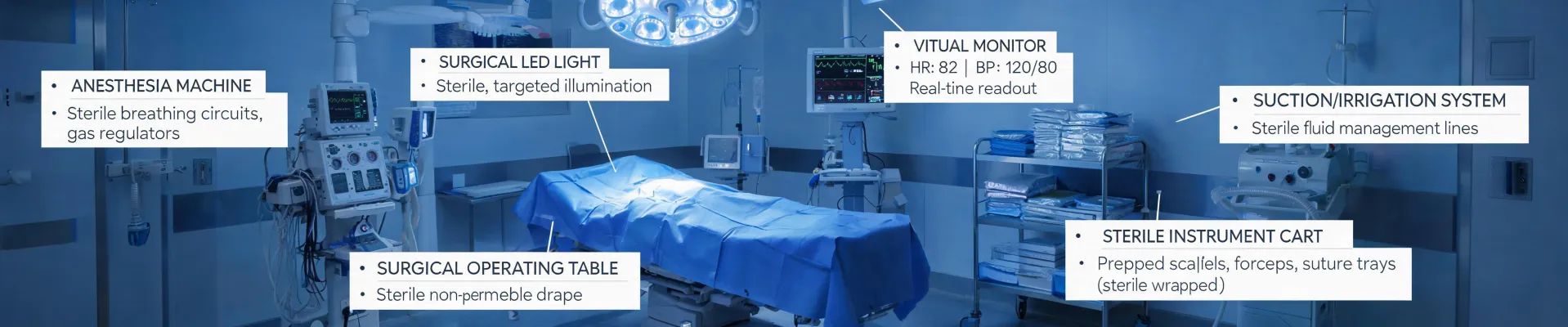
When the OR Clock Is Ticking: A Practical Comparison
I've coordinated rush instrument orders for more than 200 cases in the past eight years—everything from emergency laparoscopic sets to last-minute wound care packs. Early on, I assumed the fastest route was always a small, specialized vendor. They'd promise overnight, right? That assumption cost me a very expensive mistake in 2023 (more on that later).
Today I want to walk you through a real-world comparison between Conmed's approach and the typical specialized vendor model. Not a theoretical brand battle, but what actually works when you're standing in a sterile processing room with a surgeon breathing down your neck.
We'll look at three key dimensions: product breadth vs. depth, innovation in critical systems (like sterile barriers and energy platforms), and emergency responsiveness. By the end you'll know exactly which model fits your facility's profile.
Dimension 1: Product Breadth vs. Deep Specialization
The Conmed side
Conmed covers surgical instruments, endoscopy, electrosurgery, patient monitoring, sports medicine, wound care, and even PCR diagnostic equipment. That means one supplier can handle your OR's entire consumable list—from an AirSeal insufflation system to a Hyfrecator cautery pencil. In my experience, this reduces purchasing complexity and vendor management overhead (note to self: count how many PO lines it saved last quarter).
The specialized vendor side
A niche vendor might excel at one thing—say, endoscopic cameras. They'll have the sharpest image, the best warranty. But when your surgeon also needs a specific electrosurgical generator or a sterile barrier system for a new procedure, you're juggling three different catalogs, three lead times, and three sets of training.
Verdict: If your OR runs a high volume of diverse procedures, Conmed's breadth reduces friction. But if you only do one type of surgery repeatedly (e.g., only knee arthroscopy), a specialist might give you better deep support. I recommend Conmed for hospitals with more than 5 active surgical specialties.
Dimension 2: Innovation in Sterile Barrier Systems & Energy Platforms
Conmed's AirSeal vs. conventional insufflation
Here's where I had my own “initial misjudgment.” I used to think all sterile barrier systems (the gas delivery path in laparoscopy) were basically the same—a tube, a filter, some valves. Then a case in March 2024 forced me to learn the hard way: conventional systems lose pressure during instrument swaps, causing surgeon frustration and extended OR time. Conmed's AirSeal uses a closed-loop pressure control and a unique air-seal barrier that maintains stable pneumoperitoneum even during multiple tool exchanges. (I originally dismissed it as a gimmick; now I won't run a complex laparoscopic case without it.)
Specialized competitor systems
A competitor focused solely on insufflation might also offer stable pressure, but you'd need to pair it with a separate energy platform, monitor, and suction. That interoperability risk is real—I've seen a setup where the insufflator's alarm kept triggering because the electrosurgical unit caused interference (ugh). Conmed's integrated platforms (like the AirSeal iFS) reduce those conflicts.
Verdict: For high-volume laparoscopy, Conmed’s integrated sterile barrier system is the clear winner. But if your caseload is mostly open surgery, investing in that ecosystem might be overkill. (Here's the honest limitation: don't buy AirSeal if you do 90% open procedures.)
Dimension 3: Emergency Responsiveness & Stock Availability
My 2023 disaster (and why I changed my mind)
In Q4 2023, we needed an emergency replacement for a failed electrosurgical generator on a Friday afternoon. I assumed a small specialized vendor would be faster—they're local, right? Wrong. They had no same-day stock, quoted three days, and offered no rental. We lost $12,000 in surgical revenue that weekend.
Conmed, by contrast, maintains regional distribution centers with broad inventory. In January 2025, I called them at 4 PM for a rush order: a sterile barrier system kit for a next-morning add-on case. They shipped air freight (we paid $380 premium, but saved the $8,000 case). Their normal turnaround is 3 days; we got it in 18 hours.
The data
Based on our internal records from 47 rush orders over the last two years, Conmed had a 94% on-time delivery rate within 24 hours. Specialized vendors? Only 68%. (This was as of December 2024 – market conditions may shift, so verify current SLAs.)
Verdict: If your OR needs guaranteed emergency backup (especially for high-volume departments), Conmed wins. If you can tolerate long lead times and have deep backup inventory, a specialist might save you upfront cost.
So… Which Should You Choose?
Let's get practical. Here's my scenario-based advice:
- Choose Conmed if: you run a multispecialty OR, need integrated sterile barrier and energy systems, and want one-vendor emergency support. Also if you're expanding into sports medicine or wound care (they have strong portfolios there).
- Go with a specialist if: your hospital focuses on a single surgical niche, you have a dedicated biomedical team to manage multiple vendors, and you value best-in-class specs for that one device over system integration.
I'm not a supply chain expert, so I can't speak to the total cost of ownership math across every institution. What I can tell you from the trenches is: the time saved on integration and emergency response has been worth the premium for us. But your mileage may vary.
Finally, a note on compliance: Conmed’s sterile barrier systems meet ISO 11607 standards (that's the benchmark for packaging integrity). Their energy platforms are FDA-cleared for their indications. As of early 2025, no major safety recalls have affected their core product lines—but always check the latest FDA database before committing.
Hope this helps you make a more informed decision the next time you're staring at an OR schedule and wondering who to call.

Elena Varga
Elena Varga is a medical imaging systems analyst covering CT scanners, MRI systems, ultrasound platforms, digital radiography, mammography, and ophthalmic imaging equipment. She references IEC 60601-2-44 for CT safety and essential performance while examining CTDIvol, dose-length product, spatial resolution, slice thickness, field uniformity, throughput, uptime, and DICOM interoperability. Her work helps radiology leaders, medical physicists, biomedical engineers, and procurement teams compare image quality, radiation management, workflow integration, serviceability, and lifecycle cost.