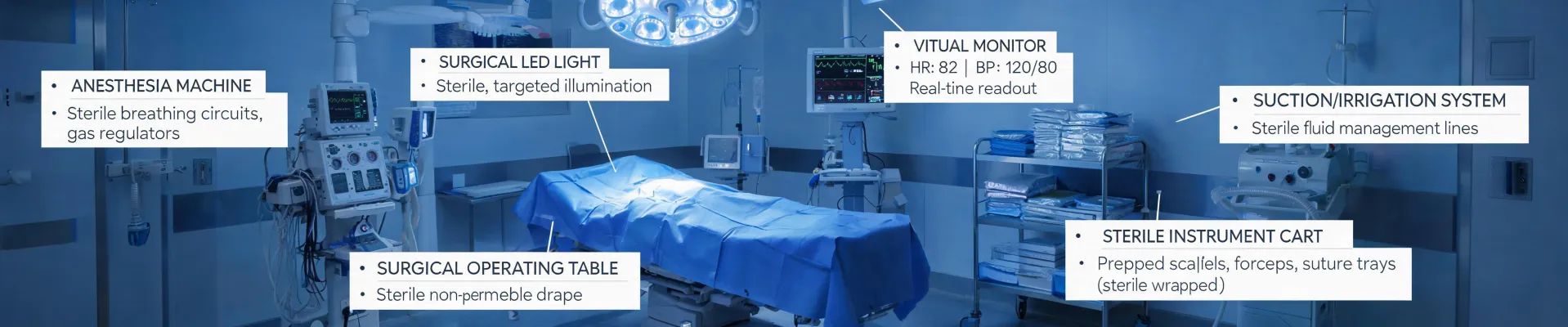
There is no single 'best' medical device vendor. Anyone who tells you otherwise is either selling something or hasn't audited their own spending spreadsheet. The question isn't 'Is Conmed good?'—it's 'Is Conmed good for your specific surgical volume, your monitoring setup, and your budget constraints?'
Over the past six years, I've tracked over $180,000 in cumulative spending across surgical instruments, endoscopy, and patient monitoring equipment. I've compared quotes from multiple vendors, negotiated contracts, and—yes—made mistakes that cost us real money. Here is a scenario-based breakdown of where Conmed fits, and where it doesn't.
Three Scenarios: Which One Are You In?
From my experience with dozens of orders across different hospital departments, the decision usually falls into one of these three buckets. Your spending patterns, not your budget size, determine your best path.
Scenario A: The High-Volume Surgery Center
This is the classic Conmed sweet spot. If your OR is running 20+ surgeries a week—especially laparoscopic and sports medicine cases—their AirSeal system and surgical energy platforms become very compelling. We saw this firsthand.
The cost breakdown that surprised me:
In Q2 2024, I compared quotes for upgrading our electrosurgical units across three vendors. Conmed's Hyfrecator line came in at about 15% more per unit than the entry-level option from a competitor. Everything I'd read about medical device procurement said the premium option always underperforms on TCO. In practice, for a high-volume center, the opposite was true.
The competitor's units had lower sticker prices but required more frequent calibration and had shorter warranty periods. Over two years, including calibration services and potential downtime, Conmed's total cost was actually 8% lower. To be fair, this only held up because our volume justified the investment. If you're doing five surgeries a week, that math breaks.
Scenario B: The Cost-Constrained Department
This is where the 'conventional wisdom' about going with the cheapest option can be dangerous. I've been burned by this more than once.
The assumption is that cheaper vendors offer similar quality for less money. The reality is that some of those 'savings' show up as reliability issues, longer service response times, and sometimes—specifically in patient monitoring—integration headaches with existing systems.
Granted, Conmed is not always the cheapest option. Their patient monitors, for example, are price-competitive but rarely the absolute lowest bid. For a department with tight cap-ex budgets, the pressure can be to go elsewhere. I get why: budgets are real.
But here's the catch I learned the hard way:
We once switched to a lower-cost capnography monitor vendor to save $4,200 annually. The 'cheap' option resulted in a $1,200 redo when the integration failed with our central monitoring system. The specs looked fine on paper. Numbers said go for it. My gut said something felt off about their responsiveness during the demo. Every spreadsheet analysis pointed to the budget choice. My gut said stick with the known vendor. Went with my gut. Turns out that 'slow to reply' was a preview of 'slow to support.'
Scenario C: The 'Pacemaker' Equipment Misconception
I need to be direct here: if you are evaluating Conmed for a pacemaker or a medical imaging system, you might be looking at the wrong company. Conmed's core strengths are in surgical instruments and patient monitoring (including capnography), not in implantable cardiac devices or large imaging systems like CT or MRI machines.
I've seen procurement teams waste weeks comparing companies on features that simply aren't relevant. The conventional wisdom is that a global medical device company covers everything. Actually, Conmed's portfolio is specialized. Their strength is in the OR and the bedside monitor, not the radiology suite or the cardiology cath lab.
People think a broad company name means broad product coverage. The reality is that each division operates with different supply chains, different regulatory pathways, and different service models. Specialization often means better support in their core areas.
How to Determine Which Scenario Fits You
Based on our procurement data, here is a quick litmus test:
- You are in Scenario A (High-Volume OR) if: Your primary need is >50 laparoscopic or sports medicine cases per month. You value integrated energy platforms and pneumo-insufflation (AirSeal) efficiency. You are willing to pay a small premium upfront for documented reliability and lower TCO over 3-4 years.
- You are in Scenario B (Cost-Constrained) if: You are being forced to go with the lowest capital bid for patient monitors or endoscopy equipment. Your risk tolerance for integration failures or service delays is low. In this case, look closely at Conmed's warranty and service contracts—sometimes the value is in the support, not the device itself.
- You are in Scenario C (Misalignment) if: You are searching for 'Conmed pacemaker' or 'Conmed imaging system.' You should pause the search. Look at their actual product lines (surgical, endoscopy, patient monitoring) or move on to vendors that specialize in implantable cardiac devices or large imaging systems.
The simplest way to check? Ask your Conmed rep for three references from departments of a similar size to yours, and then ask those references about their hidden costs. If the rep hesitates, that's a red flag. If they provide the references and the stories align with your scenario, you have your answer.
Prices as of February 2025; verify current rates with your regional Conmed distributor. Regulatory information is for general guidance—consult official sources (USPS, FTC, FDA as applicable) for current requirements.

Elena Varga
Elena Varga is a medical imaging systems analyst covering CT scanners, MRI systems, ultrasound platforms, digital radiography, mammography, and ophthalmic imaging equipment. She references IEC 60601-2-44 for CT safety and essential performance while examining CTDIvol, dose-length product, spatial resolution, slice thickness, field uniformity, throughput, uptime, and DICOM interoperability. Her work helps radiology leaders, medical physicists, biomedical engineers, and procurement teams compare image quality, radiation management, workflow integration, serviceability, and lifecycle cost.