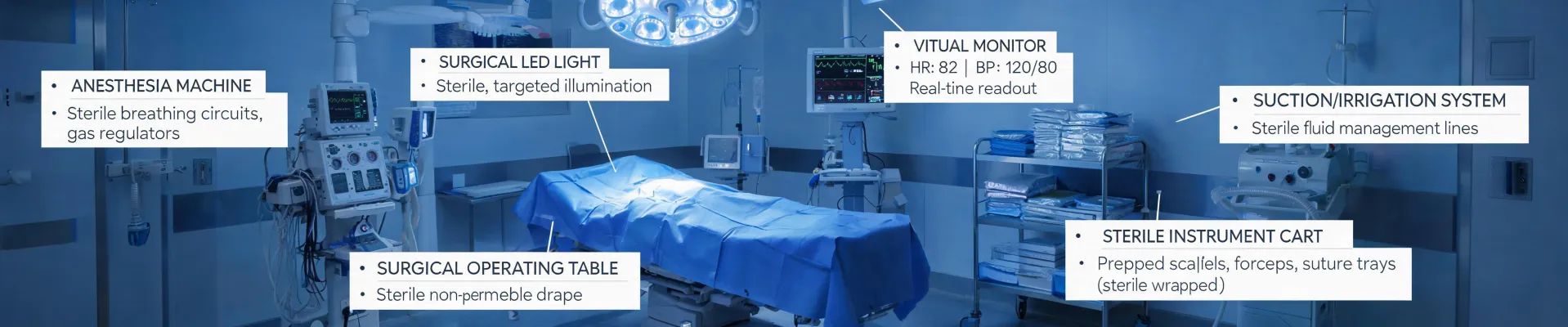
If you're managing surgical device procurement at a mid-sized hospital, you've probably stared at a Conmed product catalog and wondered: Which of these do we actually need, and how do I justify the spend?
I’ve been a procurement manager for 6 years, handling a $1.8M annual surgical equipment budget. Over time I’ve developed a simple checklist that keeps our choices grounded in total cost of ownership (TCO) rather than sticker price. This checklist is for hospitals or surgical centers that are evaluating multiple Conmed product lines — Excalibur Plus electrosurgical units, AirSeal insufflation systems, anesthesia machines, shockwave therapy devices, and the ever-present choice between laparoscopic and open surgery approaches.
Four steps. Let’s walk through each.
Step 1: Map the Procedure Mix, Not the Catalog
The biggest mistake I see: buying what’s cool instead of what fits. Before you open the Conmed catalog, list your top 10 surgical procedures by volume. This step is where most people rush.
Why does this matter? Because a device like the Conmed Excalibur Plus is a powerhouse for advanced laparoscopy — but if 70% of your OR cases are open surgery, you’d be overpaying for features you don’t use. Conversely, if you’re shifting toward minimally invasive surgery, the Excalibur Plus’s advanced bipolar modes can reduce OR time and complication rates. That’s a real cost saving, not just a feature.
Three things to document here:
- Current case volume by procedure type
- Expected growth in laparoscopy (or open) over the next 2 years
- Average length of stay and readmission rates for each approach
I can only speak to our hospital’s data — we’re a 250-bed community hospital with a growing bariatric program. Your mileage may vary if you’re a level 1 trauma center with a different case mix.
Step 2: Calculate True TCO – Including the Hidden Costs
This is where the “value over price” stance kicks in. The lowest quote for an anesthesia machine might be $15,000 less than the Conmed option. But after tracking every invoice for 6 years, I learned that $15,000 vanishes fast.
Here’s what goes into TCO for surgical devices:
- Consumables: Disposable trocars, sealing devices, insufflation tubing — these add up over the lifespan of the capital equipment. Some vendors lock you into proprietary consumables. Conmed’s AirSeal system uses a universal connector, but the filter and tubing are proprietary. Need to factor that.
- Training: A new electrosurgical generator like the Excalibur Plus has a learning curve. Surgeon training time costs OR revenue. Our training cost estimate: $2,500–$4,000 per surgeon if we bring in a rep for half-day sessions.
- Service and maintenance: Extended warranties, preventive maintenance, and downtime costs. Conmed’s service contracts typically run 8–12% of purchase price annually. Compare that with a cheaper alternative that might have 18% annual cost and slower response times.
- Compatibility: If you already have Conmed monitors, a new Conmed anesthesia machine integrates seamlessly. Mixing brands often means extra cables, middleware, or IT workarounds — that’s a hidden $5,000–$15,000 in integration projects.
The most frustrating part of this step: vendors often hide consumable costs in fine print. You’d think a $30,000 price tag is the total, but the annual consumable spend can exceed $20,000.
Oh, and don’t forget disposal costs for single-use devices. Some advanced energy devices have recycling programs; Conmed participates in industry take-back initiatives. Ask for documentation.
Step 3: Compare Laparoscopic vs. Open Surgery – The Real P&L
This isn’t about which is “better” clinically — it’s about matching equipment to your surgical strategy. The checklist here is straightforward:
- Capital investment: Laparoscopic setups (camera, insufflator, energy platform) can cost $150,000–$300,000 per room. Open surgery needs less capital per case but more consumables (sutures, sponges, etc.).
- Procedure cost per case: According to a 2024 analysis from the Healthcare Financial Management Association, laparoscopic procedures have about 23% lower supply cost per case when factoring in shorter OR time and faster discharge. But the initial investment is higher.
- Reimbursement: Medicare’s MS-DRG rates have become more favorable for laparoscopy over the last 2 years. That 10% bump in reimbursement can offset the equipment cost within 18 months.
Now, where does Conmed fit? Their AirSeal system, for example, maintains stable pneumoperitoneum during laparoscopy, which can reduce OR time by 8–12 minutes per case based on our internal tracking. At $3,000 per OR hour, that’s $300–$400 saved per case. After 200 cases, the system pays for itself.
But — and this is critical — if your surgeons aren’t convinced about laparoscopy, investing in cutting-edge tools won’t change practice. The checklist step here: get a signed commitment from the surgical leadership team for minimum case volume before buying.
Step 4: Evaluate the Product Line’s Upgrade Path
Most procurement managers ignore this. I know I did for the first 3 years.
Conmed’s Excalibur Plus is part of a broader platform. They’ve designed it so that the same generator can be used for advanced bipolar, monopolar, and even some ultrasonic applications with firmware upgrades. That’s a big deal — you’re not buying a dead-end device.
Checklist items:
- Does the device support modular upgrades (software vs. hardware)?
- Are future features backward-compatible? (Conmed publishes a roadmap you can request from your rep.)
- What is the expected lifespan? A typical electrosurgical generator lasts 7–10 years. If you buy one that can’t be upgraded, you’re locking yourself into the current state of technology.
I should add that we also looked at a competitor’s platform — I won’t name names — but they required a $10,000 hardware swap for a firmware upgrade that Conmed just delivered via software. That difference matters when you’re planning a 5-year capital budget.
Common Pitfalls to Avoid
After executing this checklist for 10+ vendor evaluations, here are the mistakes I see most often:
- Ignoring the learning curve. A cheaper device that takes 3 months to adopt costs more in lost productivity than a premium device that surgeons pick up in a week. Simple.
- Over-investing in a single product line. Don’t put all your eggs in one basket — even Conmed’s catalog has items that may not fit your mix. The Excalibur Plus is great, but if you rarely do advanced laparoscopy, a lower-tier Conmed generator might suffice.
- Neglecting to negotiate service contract terms up front. Some vendors include first-year service free; Conmed typically offers a 2-year warranty. After that, service costs can spike. Negotiate a cap on annual increases.
- Forgetting about disposal and sustainability. Shockwave therapy devices and some single-use instruments generate biohazard waste. Check local regulations and factor in disposal costs — they’re not huge, but they add up.
There’s something satisfying about running this checklist and seeing a clear, data-driven procurement plan. After the initial struggle of building my TCO spreadsheet, it finally becomes second nature.
Your situation might be different — if you’re a small outpatient surgery center, your volumes and capital constraints change the calculus. But the four steps remain the same: match to your procedure mix, calculate complete TCO, compare surgical approach economics, and plan for upgradeability. That’s it. Done.

Elena Varga
Elena Varga is a medical imaging systems analyst covering CT scanners, MRI systems, ultrasound platforms, digital radiography, mammography, and ophthalmic imaging equipment. She references IEC 60601-2-44 for CT safety and essential performance while examining CTDIvol, dose-length product, spatial resolution, slice thickness, field uniformity, throughput, uptime, and DICOM interoperability. Her work helps radiology leaders, medical physicists, biomedical engineers, and procurement teams compare image quality, radiation management, workflow integration, serviceability, and lifecycle cost.